Introduction
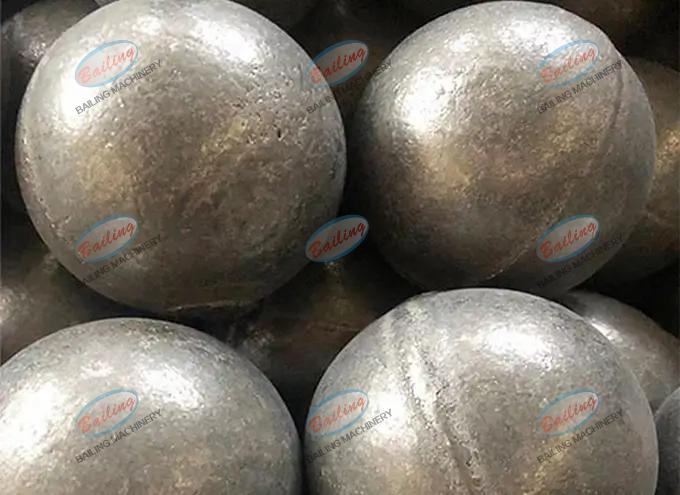
Ball mill cast steel balls are typically used in various cement plants, chemical plants, power plants, quartz sand plants, silica sand plants, etc. for large-scale mining. Forged steel balls have good surface quality, excellent impact resistance, strong toughness, good wear resistance, and are not prone to breakage or loss of roundness. The forging and stamping methods we use involve heating the metal until the temperature reaches 1050 ° C(±50 ° C), and then applying pressure to the metal billet with forging machinery to cause plastic deformation, thereby obtaining forgings with certain mechanical properties, shapes and sizes.
Cast steel balls can be classified into three categories, including high-chromium balls, medium-chromium balls and low-chromium balls.
01. Quality indicators of high-chromium balls
The chromium content of high-chromium balls is greater than or equal to 10.0%. The carbon content is between 1.80% and 3.20%. According to national standards, the hardness of high-chromium balls must be no less than 58hrc, and the impact value should be greater than or equal to 3.0j/cm ². To achieve this hardness, high-chromium balls must undergo high-temperature quenching and tempering treatment. At present, there are two methods for quenching high-chromium balls in China, including oil quenching and wind quenching. If the hardness of the high-chromium ball is lower than 54HRC, it indicates that it has not undergone quenching treatment.
02. Quality indicators of medium chromium balls
The chromium content of medium chromium balls is specified to range from 3.0% to 7.0%, and the carbon content is between 1.80% and 3.20%. Its impact value should be no less than 2.0j/cm ². The national standard stipulates that the hardness of chromium balls should be greater than or equal to 47hrc. To ensure quality, medium chromium balls should undergo high-temperature tempering treatment to eliminate casting stress.
If the surface of the steel ball appears blackish red, it indicates that the steel ball has undergone high-temperature tempering treatment. If the surface of the steel ball still retains its metallic luster, we can determine that the steel ball has not undergone high-temperature tempering treatment
03. Quality indicators of low-chromium balls
Generally speaking, the chromium content of low-chromium balls ranges from 0.5% to 2.5%, and the carbon content is from 1.80% to 3.20%. Therefore, in accordance with national standards, the hardness of low-chromium balls should be no less than 45hrc and the impact value should be no less than 1.5j/cm ². Low-chromium balls also require high-temperature tempering treatment to ensure quality. This treatment can eliminate casting stress. If the surface of the steel ball is deep red, it indicates that it has undergone high-temperature tempering treatment. If the surface still shows its metallic color, it indicates that the steel ball has not undergone high-temperature tempering.
Cast steel balls are typically used in various cement plants, chemical plants, power plants, quartz sand plants, silica sand plants, etc. for large-scale mining.
Forged steel balls have good surface quality, excellent impact resistance, strong toughness, good wear resistance, and are not prone to breakage or loss of roundness. The forging and stamping methods we use involve heating the metal until the temperature reaches 1050 ° C(±50 ° C), and then applying pressure to the metal billet with forging machinery to cause plastic deformation, thereby obtaining forgings with certain mechanical properties, shapes and sizes.
Forging can eliminate the casting porosity and other defects produced during the smelting process of metals, optimize the microstructure, and at the same time, because the complete metal flow lines are preserved, the mechanical properties of forgings are generally better than those of castings made of the same material. For forged steel balls to be wear-resistant, the most wear-resistant materials must be selected, or high-efficiency wear-resistant alloy steel materials independently developed by some companies.
Forged steel balls have precise dimensions, high roundness, high hardness and mechanical properties. It is wear-resistant, not prone to deformation or breakage. This can be fully reflected by the high overall hardness. The surface hardness is as high as 57hrc to 67hrc, and the volume hardness is as high as 56hrc to 64hrc. The hardness distribution is uniform, and the impact toughness is greater than 12j/cm2. The breakage rate is low, and the resistance of the skin fragments exceeds 20,000 times. The actual breakage rate is no more than 1%, close to 0.
We made a comparison between cast steel balls and forged steel balls in domestic iron ore plants. The results of the two were 0.9 kilograms per ton and 0.6 kilograms per ton respectively. From the data, we can see that by using forged steel balls, the wear of one ton of ore consumed is reduced by 33.3%.
Parameter
| Model | Rotational speed(r/min) | Balls weight(t) | Feeding size(mm) | Output size(mm) | Capacity(t/h) | Motor power(kw) | Weight(t) |
| Ф900×1800 | 42 | 1.4 | ≤20 | 0.075-0.89 | 0.65-2 | 18.5 | 3.6 |
| Ф900×2100 | 41 | 1.7 | ≤15 | 0.075-0.83 | 0.7-3.5 | 15 | 3.9 |
| Ф900×3000 | 41 | 2.7 | ≤20 | 0.075-0.89 | 1.1-3.5 | 22 | 4.5 |
| Ф1200×2400 | 36 | 3.5 | ≤25 | 0.075-0.6 | 1.5-4.7 | 30 | 11.5 |
| Ф1200×2800 | 31 | 6.8 | ≤25 | 0.075-0.6 | 1.5-5 | 37 | 13 |
| Ф1200×4500 | 32 | 5.5 | ≤25 | 0.074-0.4 | 1.6-5.8 | 55 | 13.8 |
| Ф1500×3000 | 31 | 6.8 | ≤25 | 0.074-0.4 | 2-7 | 75 | 17 |
| Ф1500×4500 | 27 | 10.5 | ≤25 | 0.074-0.4 | 3.5-8 | 110 | 21 |
| Ф1500×5700 | 27 | 15 | ≤25 | 0.074-0.4 | 3.5-10 | 130 | 24.7 |
| Ф1830×3000 | 26 | 13 | ≤25 | 0.074-0.4 | 4-12 | 160 | 28 |
| Ф1830×3600 | 26 | 15 | ≤25 | 0.075-0.4 | 5-13 | 160 | 33.5 |
| Ф1830×4500 | 26.5 | 17 | ≤25 | 0.075-0.6 | 5.5-20 | 185 | 35 |
| Ф1830×7000 | 26 | 25 | ≤25 | 0.074-0.4 | 6.5-22 | 210 | 36 |
| Ф2100×3600 | 24 | 21 | ≤25 | 0.074-0.4 | 6.5-22 | 185 | 46.8 |
| Ф2200×5500 | 21 | 30 | ≤25 | 0.074-0.4 | 10-20 | 245 | 48.5 |
| Ф2200×6500 | 21.7 | 35 | ≤25 | 0.074-0.4 | 14-26 | 380 | 52.8 |
| Ф2200×7500 | 21 | 33 | ≤25 | 0.074-0.4 | 16-30 | 380 | 56 |
| Ф2400×3000 | 20.6 | 30 | ≤25 | 0.075-0.4 | 15-50 | 245 | 59 |
| Ф2400×4500 | 21 | 33 | ≤25 | 0.074-0.4 | 15-60 | 380 | 65 |
| Ф2700×3600 | 20.6 | 39 | ≤25 | 0.074-0.4 | 20-70 | 400 | 91.3 |
| Ф2700×4000 | 20.7 | 40 | ≤25 | 0.074-0.4 | 20-80 | 400 | 94 |
| Ф2700×4500 | 20.7 | 48 | ≤25 | 0.074-0.4 | 20-90 | 430 | 102 |
| Ф3200×4500 | 18 | 65 | ≤25 | 0.075-0.4 | according to the process conditions | 800 | 137 |