Project Background
This deposit is a typical polymetallic sulfide gold deposit. The gold mainly exists in the form of fine-grained inclusions in pyrite (accounting for 85% of sulfur minerals) and arsenopyrite (As₂S₂, accounting for 15%), and some of the gold exists in a free state in gangue fractures. The customer is confronted with the following core issues:
- Low gold recovery rate: The traditional cyanide leaching process has an leaching rate of only 65% due to the interference of arsenic minerals
- Difficulty in arsenic suppression: The floatability of toxic sand and pyrite is similar, and the arsenic content in the concentrate exceeds the standard (As > 0.5%), which affects the subsequent smelting;
- The loss of fine-grained gold is significant: gold of -38μm size accounts for 40% of the total, and the recovery rate of traditional flotation is less than 50%.
Analysis of Ore Characteristics
| Element | Au(g/t) | As(%) | S(%) | Fe(%) | SiO₂(%) |
| Content | 2.1 | 0.8 | 12.5 | 18.3 | 45.2 |
| The state of gold endowment | Pyrite inclusions (60%) | The main components of toxic sand | The main components of pyrite | Gangue cementation | The main components of gangue |
Process design
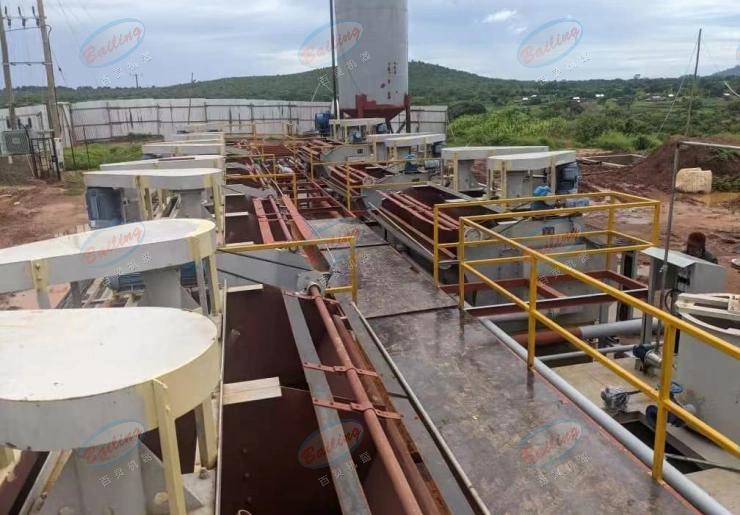
In view of the characteristics of the ore, a combined process of “staged grinding – arsenopyrite separation – gold priority flotation – fine-grained gold carrier recovery” is adopted. The core process is as follows:
- The first section is crushed to -15mm by a jaw crusher and a cone crusher
- The two-stage ball mill and the hydrocyclone form a closed circuit to control the grinding fineness of -0.074mm, accounting for 75%, ensuring the full dissociation of gold minerals.
- The -38μm fine sludge (with a yield of 20%) was separated by high-frequency fine screening and treated separately to reduce interference with the main process.
- Oxidation calcination: The grinding product is subjected to low-temperature calcination (450℃, 30 minutes) to form hydrophilic FeAsO₄ on the surface of the toxic sand, reducing its floatability.
- Magnetic separation for iron removal: Weak magnetic separation (0.1T) is adopted to pre-recover part of the magnetic iron minerals (Fe grade 52%), reducing the consumption of subsequent flotation reagents
- Slurry preparation: Add lime (pH=10.5) and lead nitrate (150g/t) to activate the gold in pyrite.
- Inhibitor: A combined inhibitor (lime: sodium sulfite =2:1, total dosage 1000g/t) is used to inhibit toxic sand.
- Collector: Use a mixed collector of butyl xanthate (80g/t) and ethyl sulfide nitrogen (40g/t) to enhance the selective recovery of gold.
- Foaming agent: Add No.2 oil (25g/t), and through the process of one crude, two refiners and two sweeps, obtain gold crude concentrate (Au grade 8.5g/t, recovery rate 78.2%).
- The “carrier flotation” technology was adopted for -38μm fine sludge:
- Add 5% coarse-grained pyrite (with a particle size of 0.1 to 0.5mm) as a carrier;
- Diesel (200g/t) is used as a hydrophobic agent to make fine-grained gold adhere to the surface of the carrier;
- The carrier-gold complex was recovered through flotation, and the final fine gold recovery rate was increased to 65%.
- The crude gold concentrate and fine-grained gold carrier concentrate were combined, and after concentration and filtration, the final gold concentrate (Au grade 12.3g/t, recovery rate 85.6%) was obtained.
- The arsenic content in the concentrate has been reduced to 0.3%, meeting the standard for furnace entry in smelters (As < 0.5%).
Technological innovation points
- Selective oxidation of toxic sand through low-temperature roasting at 450℃, combined with weak magnetic separation to separate iron minerals in advance, reduces the dosage of subsequent flotation reagents by 30%.
- The use of coarse-grained pyrite as a carrier to recover fine-grained gold addresses the issue of low recovery rate of -38μm gold in traditional flotation.
- The synergistic effect of lime and sodium sulfite achieves efficient inhibition of toxic sand under pH=10.5, while reducing the inhibition of pyrite.
- The final total recovery rate of tailings reached 92.3%.
- Magnetic separation tailings are used to produce construction sand, achieving zero waste discharge
Implementation effect
1. The indicators have significantly improved:
• The total gold recovery rate has increased from 65% in the traditional process to 85.6%;
• The arsenic content in the concentrate has been reduced from 1.2% to 0.3%, meeting the requirements for smelting;
2. Economic benefit:
• The annual increase in gold income is approximately 120 kilograms (exceeding 50 million yuan based on the current gold price).
• The cost of chemicals has been reduced by 25%, and electricity consumption has decreased by 18%.=0.18