Project Background
This deposit is a weathering product of a shallow, low-temperature hydrothermal gold deposit. The gold mainly exists in the form of free or fine-grained inclusions in iron oxide minerals (such as limonite) and clay minerals, and part of the gold is adsorbed by organic carbon (the “gold robbery” phenomenon).
The customer is confronted with the following core issues:
- The traditional process is costly: cyanide leaching requires fine grinding to -0.074mm, accounting for 90%, and electricity consumption and chemical agent costs account for 60% of the operating costs
- The “gold hijacking” effect is significant: the organic carbon in the ore leads to a gold leaching rate of less than 50%.=0.5
- High environmental protection pressure: The treatment cost of cyanide tail liquid is high, and local water resources are scarce
Analysis of Ore Characteristics
| Element | Au(g/t) | S(%) | C(%) | Fe₂O₃(%) | SiO₂(%) |
| Content | 1.8 | 0.2 | 0.1 | 35.2 | 48.6 |
| The state of gold endowment | free state(60%) | Trace amounts exist | Organic carbon adsorption(15%) | The main components of limonite | Clay mineral cementation |
| Size distributio | -10mm accounts for 85% |
Process design
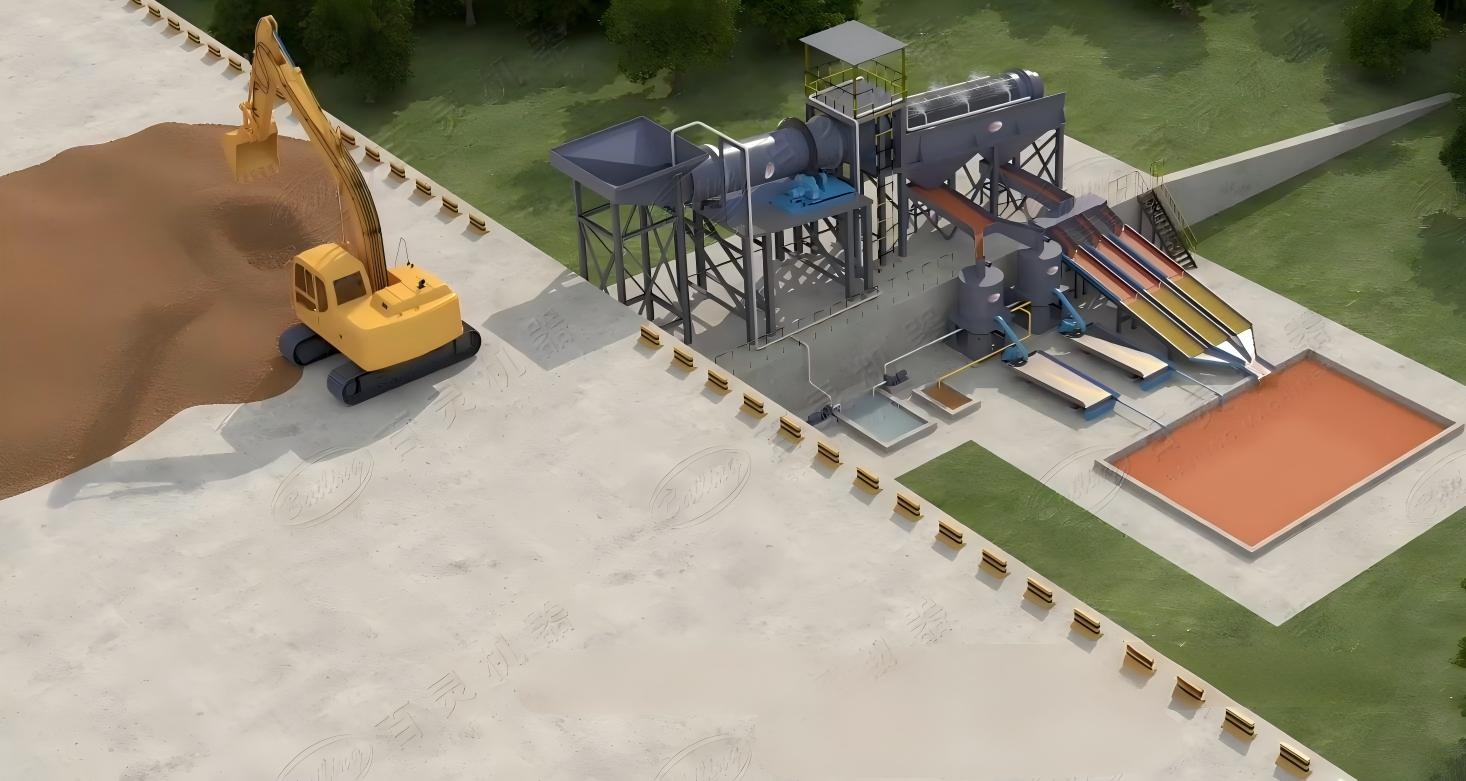
In view of the characteristics of the ore, a combined process of “low-cost crushing – pretreatment decarbonization – pile construction and spraying – environmentally friendly tail liquid treatment” is adopted. The core process is as follows
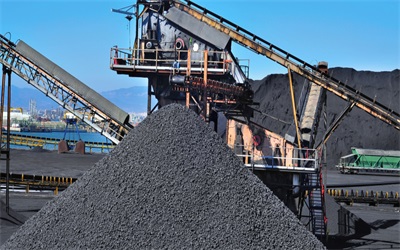
- The ore is crushed to -10mm (no fine grinding required) by using a jaw crusher and a cone crusher. The +10mm coarse particles (yield 5%) are separated through a vibrating screen and directly discarded (Au grade < 0.5g/t).
- The energy consumption for crushing is reduced by 70% compared with the traditional grinding process.
- Calcination decarburization: Low-temperature calcination (350℃, 20 minutes) is carried out on -10mm ore to oxidize organic carbon to CO₂, eliminating the “gold robbery” effect.
- Water washing and dust removal: After roasting, the ore is washed by spray water to remove dust and soluble impurities, and at the same time, part of the heat is recovered to preheat the spray water
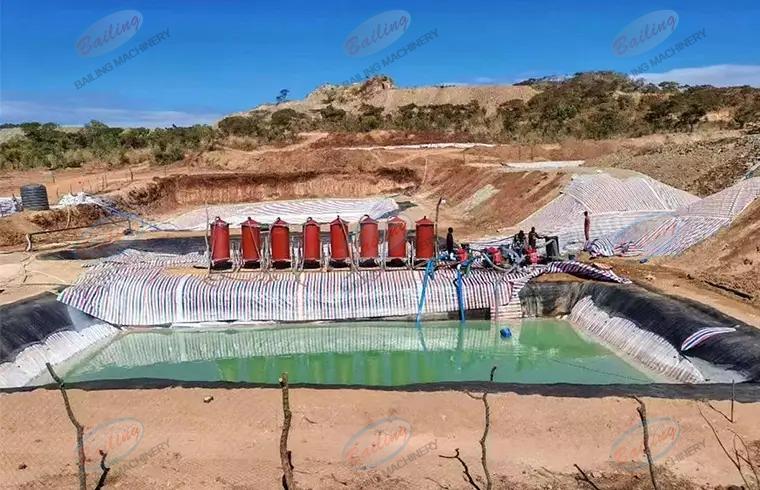
- Pile construction: The decarbonized ore is piled up in a trapezoidal shape (bottom width 50m, top width 15m, height 8m), with a slope of 1:1.5. HDPE anti-seepage membranes and seepage pipes are laid
- Spray system: A high-pressure spray device is adopted, with the spray intensity controlled at 8L/(m²·h), and the spray liquid is a 0.3‰ sodium cyanide (NaCN) solution with a pH of 10.5.
- Leaching cycle: Continuous spraying for 60 days. Monitor the gold concentration of the leachate daily. Stop the spraying when the concentration drops to 0.01mg/L.
- Pregnant solution: The leachate is collected through a percolation tube and adsorbed by an activated carbon adsorption column (coconut shell carbon). The saturated carbon is sent to the desorption electrolysis system.
- Desorption and electrolysis: High-temperature and high-pressure desorption (130℃, 0.3MPa) is adopted to electrolyze and produce gold sludge (Au grade ≥60%).
- Tail liquid treatment: The leached tail liquid is oxidized with hydrogen peroxide to break down cyanide (pH=11, reaction time 2 hours). After the cyanide (CN⁻) concentration is detected to be less than 0.1mg/L, it is recycled, reducing water consumption by 80%.
Technological innovation points
- Selective oxidation of organic carbon by low-temperature calcination at 350℃ avoids the oxidation loss of gold minerals and reduces energy consumption (40% more energy-efficient than high-temperature calcination).
- The stability of the reactor is enhanced through trapezoidal design. Combined with the layered arrangement of the percolation tubes, the uniformity of solution penetration is improved, and the leaching rate is increased by 12%.
- The cyanide-breaking tail liquid, after being deeply treated with ion exchange resin, is recycled and sprayed, achieving zero discharge of water resources and saving over 2 million yuan annually.
- By using a low-cost leaching agent of “sodium cyanide + lime” instead of the traditional combination of “sodium cyanide + lead salt”, the cost of the reagent is reduced by 35%
Implementation effect
1. The indicators have significantly improved:
• The gold leaching rate has increased from 48% in the traditional process to 82%, and the total recovery rate has reached 79%;
• The unit cost dropped from 120 yuan per gram of gold to 65 yuan per gram of gold, a reduction of 46%
2. Environmental protection effect:
• The recycling rate of cyanide tail liquid is 95%, reducing wastewater discharge by 180,000 tons annually;
• The flue gas from the roasting process is discharged up to standard after being treated with bag filter dust removal and limestone wet desulfurization, with the SO₂ emission concentration being less than 50mg/m³.