Lead-Zinc Ore Beneficiation Flowsheets
The beneficiation flowsheets for sulfide lead-zinc ores can be broadly categorized into direct preferential flotation, mixed-separation flotation, iso-floatability flotation, asynchronous flotation, and similar processes.
This flowsheet recovers lead, zinc, and sulfur (pyrite) products sequentially, based on the descending order of their floatability and flotation kinetics. This results in the separate production of lead concentrate, zinc concentrate, and sulfur concentrate. The advantages of this flowsheet include reduced flotation cell volume requirements and savings on flotation reagents.
In this flowsheet, all sulfide lead and zinc minerals are collectively recovered into a mixed concentrate, while the tailings are discarded directly. Subsequently, the mixed concentrate undergoes reagent removal (de-activation) followed by a specific separation stage to isolate the lead from the zinc. This flowsheet is renowned for delivering superior flotation separation results.
This process is designed for feed ores where a portion of the sphalerite exhibits floatability similar to the majority of the galena, or conversely, where a small portion of the galena exhibits floatability similar to the majority of the sphalerite. It involves an “iso-floatability” approach: during the preferential flotation of lead, a portion of the highly floatable zinc minerals is allowed to float simultaneously; subsequently, during the flotation of zinc, the remaining lead minerals are recovered alongside the zinc. Finally, the lead concentrate undergoes a zinc removal step, and the zinc concentrate undergoes a lead removal step, resulting in the separate recovery of purified lead and zinc concentrates.
During the flotation process, different minerals may exhibit identical floatability, while a single mineral species may display varying degrees of floatability. The asynchronous flotation process addresses this by conducting the mixed lead-zinc flotation in distinct stages. This approach ensures that the lead and zinc minerals—which do not float simultaneously—achieve their maximum recovery under their respective, optimal flotation conditions.
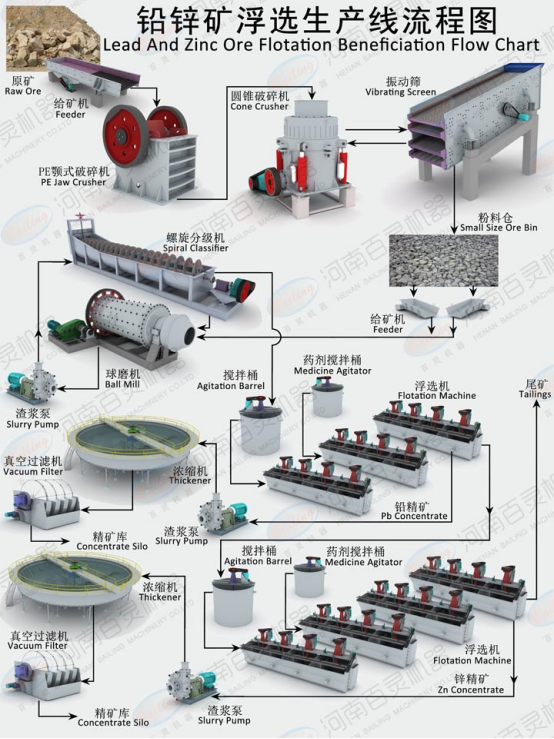
Lead-Zinc Ore Beneficiation Flowsheet
Related Case Study
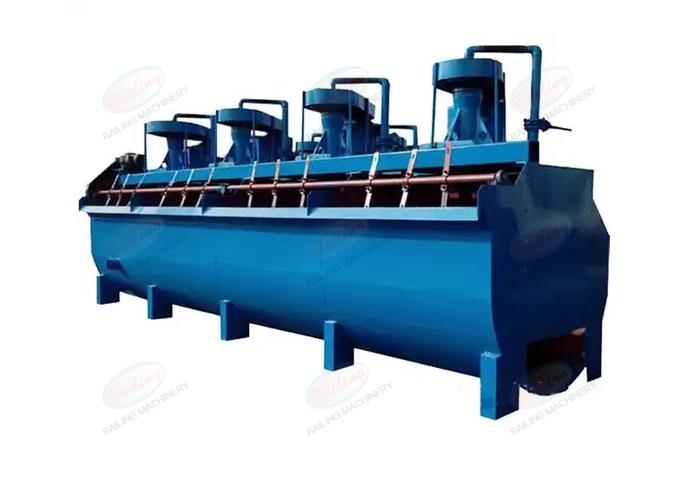
A certain sulfide lead-zinc mine in Yunnan Province had a run-of-mine ore grade of 2.2% lead and 5.9% zinc. Henan Bailing Machinery implemented a process involving priority flotation of lead followed by zinc flotation, with the ore ground to a fineness of 75% passing -200 mesh. During the lead flotation stage, sodium carbonate was used to adjust the pH to 8.5–9.0, ethyl xanthate served as the collector, and a combination of zinc sulfate and sodium sulfite was employed to depress zinc and iron-bearing minerals. Following a circuit comprising one roughing, three cleaning, and two scavenging stages, a lead concentrate was obtained. For the zinc flotation stage—utilizing the tailings from the lead circuit—sulfuric acid was used to adjust the pH to 5.5–6.0, copper sulfate was applied to activate the sphalerite, and butyl xanthate acted as the collector. A circuit consisting of one roughing, two cleaning, and one scavenging stage yielded a zinc concentrate. The final results achieved a lead concentrate grade of 68.1% with a recovery rate of 89.2%, and a zinc concentrate grade of 52.0% with a recovery rate of 92.0%. The beneficiation performance met all established standards and successfully fulfilled the client’s processing requirements.