Description
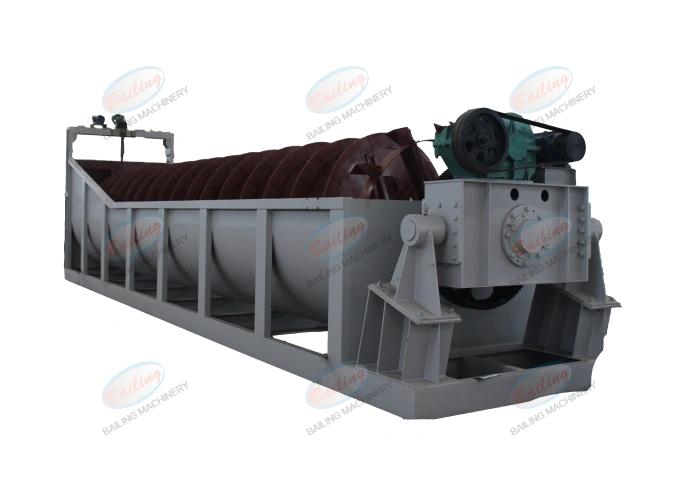
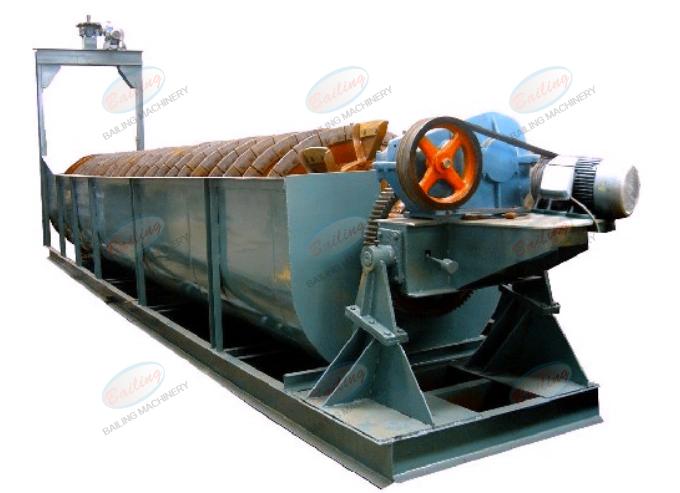
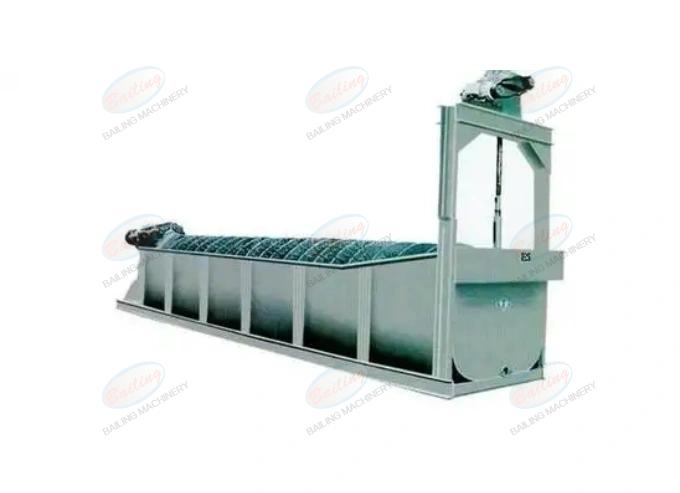
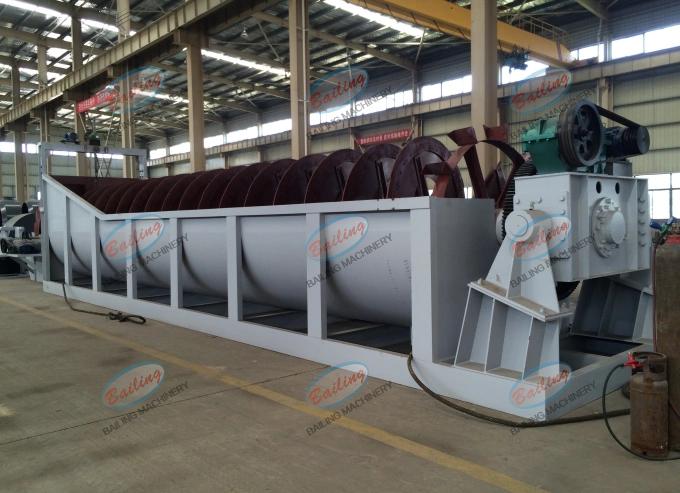
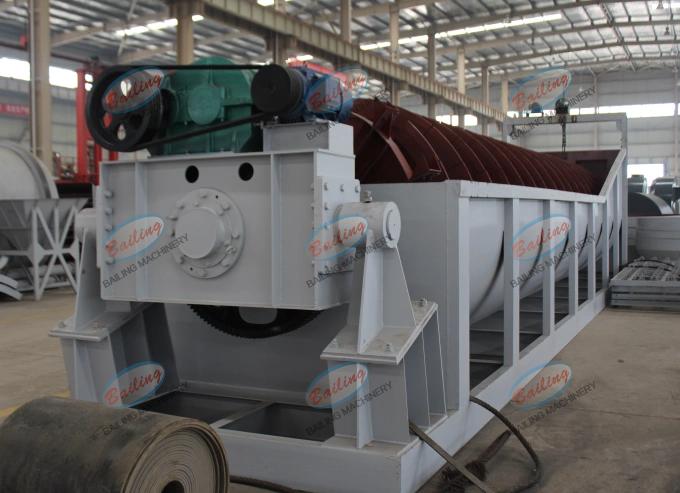
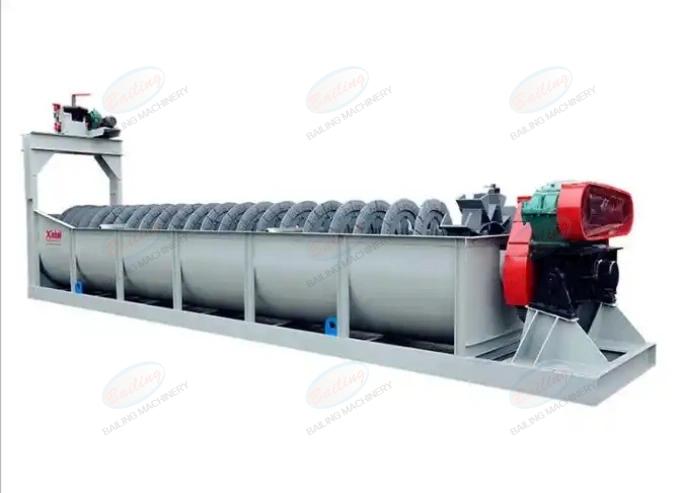
Spiral classifier is a commonly used screening and mineral processing equipment that mechanically classifies solid particles by taking advantage of their different sedimentation rates in liquids. There are mainly four types of classifiers: high weir single screw and double screw, and submerged single screw and double screw classifiers. Among them, the high weir type classifier is suitable for coarse particle classification, and the maximum overflow particle size is generally 0.4-0.15mm. The submerged classifier is suitable for fine particle classification, and the maximum overflow particle size is generally below 0.2mm.


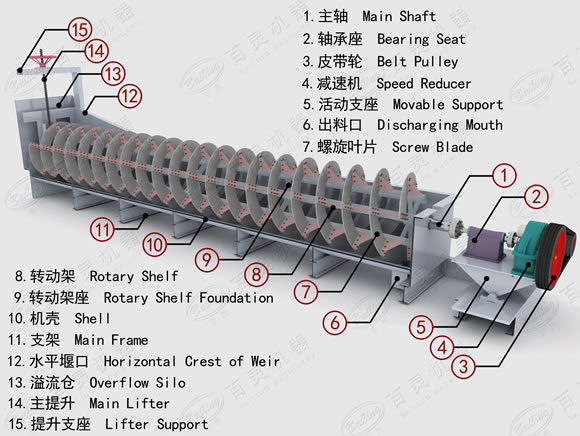
Structure drawing
Advantages
Parameter
| Model | Spiral diameter | Spiral speed(r/min) | Sand return capacity(t/d) | Overflow capacity | Water slope | Transmission motor model | Drive motor power | Lift motor model | Increase motor power | Dimensions(mm) | Weight(t) |
| FLG-508 | 508mm | 8-12 | 140-260 | 32t/d | 14-18(°) | Y132M1-6 | 4(kw) | 5340x680x1274 | 2.8 | ||
| FLG-750 | 750mm | 6-10 | 250-570 | 65t/d | 14-18(°) | Y132M2-6 | 5.5 | 6270x1240x1584 | 3.8 | ||
| FLG-915 | 915mm | 5-8 | 415-1000 | 110t/d | 14-18(°) | Y160M-6 | 7.5 | 7561x1267x2250 | 4.5 | ||
| FLG-1200 | 1200mm | 5-7 | 1165-1630 | 155t/d | 17° | Y160M-6 | 7.5 | Y90L-4 | 1.5 | 7600x1560x2250 | 7.0 |
| FLG-1500 | 1500mm | 3.5-6 | 1830-2195 | 235t/d | 17° | Y160L-6 | 11 | Y100L1-4 | 2.2 | 10200x1976x4080 | 9.5 |
| FLG-2000 | 2000mm | 3.5-5.5 | 3890-5940 | 400t/d | 17° | Y180L-6 | 15 | Y100L2-4 | 3 | 10788x2524x4486 | 16.9 |
| 2FLG-1200 | 1200mm | 5-7 | 2340-3200 | 310t/d | 12° | Y160M-6 | 7.5×2(kw) | Y100L1-4 | 2.2 | 8230x3154x3110 | 15.84 |
| 2FLG-1500 | 1500mm | 3.5-6 | 2280-5480 | 470t/d | 12° | Y160L-6 | 11×2 | Y100L1-4 | 2.2 | 10410x3392x4070 | 21.11 |
| 2FLG-2000 | 2000mm | 3.5-5.5 | 7780-11880 | 800t/d | 12° | Y180L-6 | 15×2 | Y100L2-4 | 3 | 10788x4595x4486 | 36.4 |
Note:The processing capacity varies for different materials. For detailed information, please call for consultation.
Benefits
One of the key benefits of a spiral classifier is its ability to efficiently sort particles based on their size. The spiral classifier uses gravity and centrifugal force to separate fine particles from coarse particles, ensuring an accurate classification of materials. This allows for better control over the desired particle size distribution in various industrial processes.
Spiral classifiers are known for their cost-effective operation compared to alternative sorting methods. With low power requirements and simple maintenance procedures, they offer a cost-efficient solution for particle classification in industries such as mining, aggregate production, and chemical processing. This makes them an attractive choice for businesses aiming to optimize their operational costs.
Spiral classifiers find applications in various industries due to their versatile nature. They are commonly used in mineral processing plants to classify ore or mineral slurries based on their particle size, enabling efficient separation and concentration of valuable minerals. Additionally, in aggregate production, spiral classifiers are utilized to remove fine particles from sand or crushed stone, resulting in improved product quality.
The spiral classifier’s design promotes high separation efficiency by utilizing the principle of different settling velocities of solid particles in a liquid medium. The spiral shape of the classifier chamber provides a longer settling pathway for the particles, increasing the chance for efficient separation. This ensures the removal of unwanted materials and enhances the purity of the final product.
The construction of spiral classifiers is typically robust and durable, allowing for reliable operation even in challenging industrial environments. The materials used in their fabrication are selected to withstand abrasion, wear, and corrosion, ensuring a long service life. This reliability is crucial for continuous production processes, reducing downtime and increasing overall productivity.
Spiral classifiers have a minimal environmental impact compared to other particle sorting methods. They require no additional chemicals or reagents for operation, reducing the risk of environmental contamination. Moreover, their low energy consumption contributes to reduced carbon emissions, making them a greener choice for sustainable industrial practices.
Types of Spiral Classifier
Application of Spiral Classifier
Mineral processing
One of the primary applications of the spiral classifier is in the field of mineral processing. It is used for the separation of fine particles from the coarse ones based on their size and density. The classifier’s ability to accurately classify particles allows for efficient mineral extraction and concentration.
Mining industry
In the mining industry, the spiral classifier is widely used for ore washing and desliming. It helps to remove impurities and improve the overall quality of the ore before further processing. The classifier plays a crucial role in ensuring that the right particle size is fed to the subsequent stages of mineral processing, such as flotation or magnetic separation.
Wastewater treatment
The spiral classifier is also employed in wastewater treatment plants for grit and sand removal. It helps separate and remove solid particles from the wastewater to ensure the water’s cleanliness before it is discharged or reused. The classifier’s continuous separation process is particularly effective in removing fine sand and small particles from the wastewater stream.
Aggregates industry
In the aggregates industry, the spiral classifier is used to separate coarse and fine materials during the production of concrete or asphalt. By accurately classifying particles, the classifier ensures that the right type and size of aggregates are used, resulting in high-quality construction materials.
Chemical industry
The spiral classifier finds its application in the chemical industry for the separation of solid-liquid mixtures. It is used to separate fine particles or impurities from liquid solutions or suspensions. The accurate classification provided by the classifier ensures the purity and quality of the final product, enhancing the overall efficiency of chemical processes.
Components of Spiral Classifier
- Mainframe: The mainframe is the backbone of the spiral classifier. It provides structural support and houses the other components. It is typically made of strong and durable materials to withstand the harsh working conditions in a mineral processing plant.
- Spiral shaft: The spiral shaft is a central component in the classifier. It consists of a series of interconnected blades or flights that spiral upwards. The spiral shaft rotates at a predetermined speed, creating a spiral movement that propels the ore particles upward for classification.
- Feed hopper: The feed hopper is located at the top of the spiral classifier. It receives the ore slurry or pulp from the grinding circuit and directs it into the classifier. The design of the feed hopper ensures a consistent and controlled feed rate to optimize the classification process.
- Overflow weir: The overflow weir is an adjustable mechanism located at the top of the spiral classifier. It controls the flow rate of the overflow or coarse particles. By adjusting the height of the weir, operators can control the amount of coarse material discharged from the classifier.
- Rake and spiral lifting device: The rake and spiral lifting device is responsible for removing the settled fine particles and transporting them to a collection point. It consists of a series of blades or paddles attached to the spiral shaft. As the shaft rotates, the blades lift the settled particles, allowing them to be discharged as overflow or underflow.
- Drive unit: The drive unit is the power source of the spiral classifier. It consists of an electric motor, gearbox, and drive pulleys. The motor provides the rotational power required to drive the spiral shaft, while the gearbox ensures the proper speed and torque for efficient classification.
- Submerged bearing: The submerged bearing is a critical component that supports the weight of the spiral shaft and ensures smooth rotation. It is located at the bottom of the classifier and is submerged in the feed pulp. The bearings are designed to withstand the abrasive nature of the ore pulp and require regular lubrication for optimal performance.
How does a Spiral Classifier work?
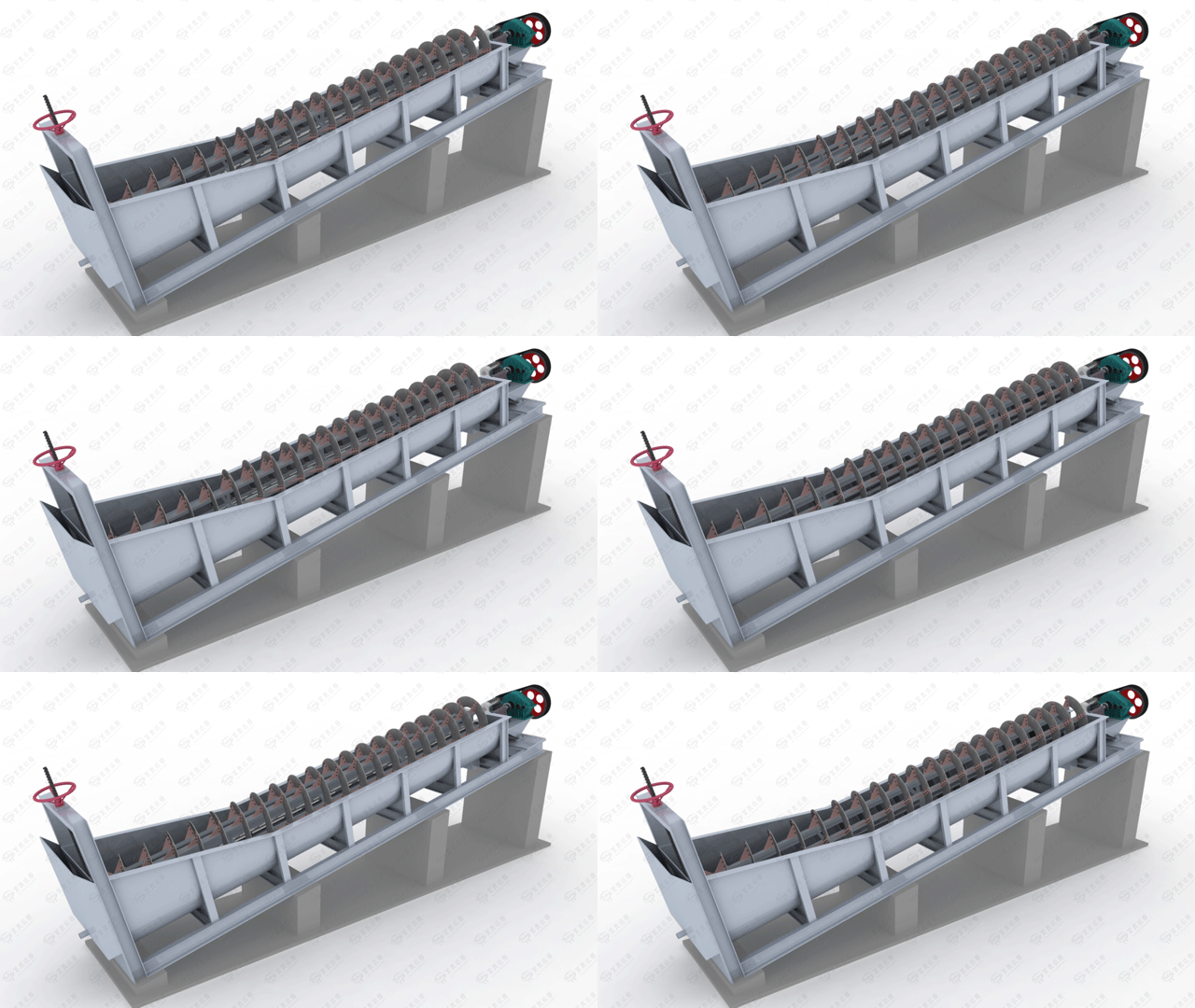
- Point 1: A Spiral Classifier separates particles in a mixture based on their size, shape, density, or a combination of these properties. It operates by introducing a slurry, which is a mixture of particles suspended in a liquid, into the upper end of a hollow, conical vessel. Inside this vessel, one or more helical, screw-like flights, known as “spirals,” are affixed to the central vertical shaft.
- Point 2: As the classifier rotates, the liquid and particles in the slurry are subjected to a combination of centrifugal forces, gravity, and hydrodynamic effects. The lighter particles, which tend to be smaller, are carried to the outer wall of the classifier by the centrifugal force and then overflow through an exit located at the top of the vessel. This is due to the design of the classifier, which creates a concentration gradient where the liquid level rises at the outer edge due to the accumulation of these fine particles.
- Point 3: Conversely, the heavier particles, which tend to be larger and have a higher density, are forced downward by the spirals against the inner surface of the classifier wall. These particles eventually fall to the bottom of the classifier and exit through a lower discharge port. The rotation of the spirals ensures that the heavier particles are continuously pushed downward against the wall and prevented from being carried out with the overflow.
- Point 4: The efficiency of the Spiral Classifier is influenced by the rotational speed of the screw mechanism, the depth of the slurry being classified, the pulp density, and the feed rate. Adjusting these variables allows operators to optimize the separation process to achieve the desired particle size distribution in the output streams. This is particularly important in mineral processing, where the liberation of valuable minerals from gangue material often requires precise control over the particle size.
What materials can be classified using a Spiral Classifier?
Ores: Spiral classifiers are widely used in the mining industry to separate and classify various types of ores. This includes valuable minerals like gold, silver, lead, zinc, copper, and more. The spiral classifier helps in separating the ore particles based on their size, shape, and density.
Coal: Coal preparation plants often use spiral classifiers to separate and classify coal particles. The classifier helps in removing impurities and achieving the desired particle size distribution, which is crucial for efficient combustion and utilization of coal.
Sand and Gravel: Spiral classifiers are commonly used in sand and gravel operations to classify the particles based on their size. This helps in producing high-quality aggregates for construction purposes. The classifier separates the coarse and fine particles, ensuring the proper grading and quality of the final product.
Industrial Minerals: Various industrial minerals such as limestone, gypsum, talc, kaolin, and clay can be classified using spiral classifiers. These minerals are often used in construction materials, ceramics, cosmetics, and other industries. The classifier helps in separating the minerals based on their size and density.
Silica Sands: Spiral classifiers are commonly used in the classification of silica sands, which are important raw materials in glass manufacturing and foundry industries. The classifier helps in separating the grains of different sizes, ensuring the desired quality and consistency of the silica sands.
Mineral Processing Waste: Spiral classifiers can be used to separate and classify the waste materials generated during mineral processing operations. This helps in recovering valuable minerals from the waste stream and reducing environmental impacts.