Copper Ore Extraction Electrowinning Process
Run-of-mine ore is fed into the primary ore bin and then via a feeder to a jaw crusher for primary crushing. The crushed product is conveyed by belt to a single-cylinder hydraulic cone crusher for secondary crushing. The secondary crushed product is then sent to a vibrating screen. The screen oversize is returned by belt conveyor to a second single-cylinder cone crusher for fine crushing, whose product is again fed to the vibrating screen, forming a closed-circuit loop. Dust generated during crushing and screening is collected and treated by a pulse-jet baghouse dust collector before being discharged up to standard. The screen undersize, comprising qualified particle size ore, is conveyed to the fine ore bin.
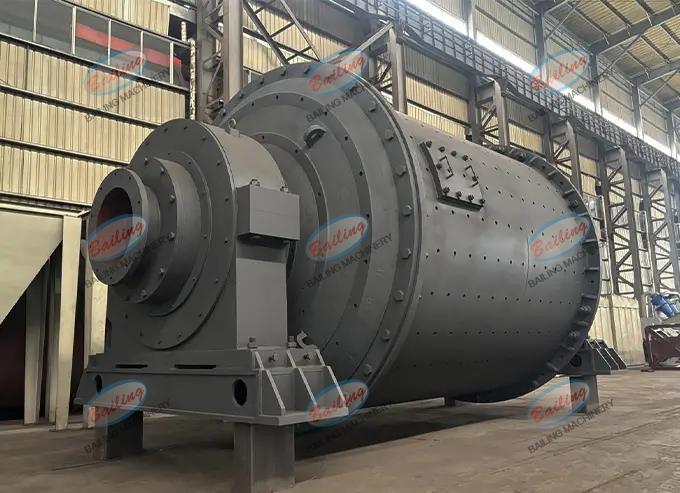
The material in the powder ore bin enters a ball mill through the conveyor. The ball mill discharges ore into the slurry pool and is pumped into the cyclone. The underflow of the cyclone returns to the ball mill to form a closed circuit. The overflow of the cyclone enters the thickener. The underflow of the thickener is pumped into the leaching tank through the pump. Sulfuric acid is added to the leaching tank for leaching. The leached slurry is washed and filtered in countercurrent by a vacuum belt filter four times to separate the copper sulfate leaching solution and tailings. The tailings are transported out of the factory and the leaching solution enters the precious liquid pool.
The leaching liquid from the precious liquid pool is pumped into the stock liquid pool for storage, and then pumped to the mixing chamber of the extraction tank to be fully mixed with the organic phase. The leaching liquid undergoes secondary countercurrent extraction. After clarification and oil removal, the raffinate is pumped into the lean liquid tank to be used as leaching washing liquid. The loaded organic phase undergoes primary washing and flows to the loaded organic phase storage tank. The clarified loaded organic phase is used as a stripping agent for stripping. After reverse extraction and filtering out the oil, the rich copper solution before electrodeposition is obtained.
Before electrowinning, the copper-rich liquid is pumped to the plate heat exchanger, then enters the high-level tank, and flows into each electrowinning tank by gravity. The insoluble anode plate is made of Pb-Ca-Sn ternary alloy, and the cathode is a processed starting electrode. The anode plate and cathode plate are hoisted into the electrowinning tank by the crane according to the pole distance for electrowinning operation. After one cycle, the cathode is sent to the plate washing tank for washing. The washed cathode becomes cathode copper after being stripped and leveled by the stripping machine and sent to the finished product warehouse after packaging.
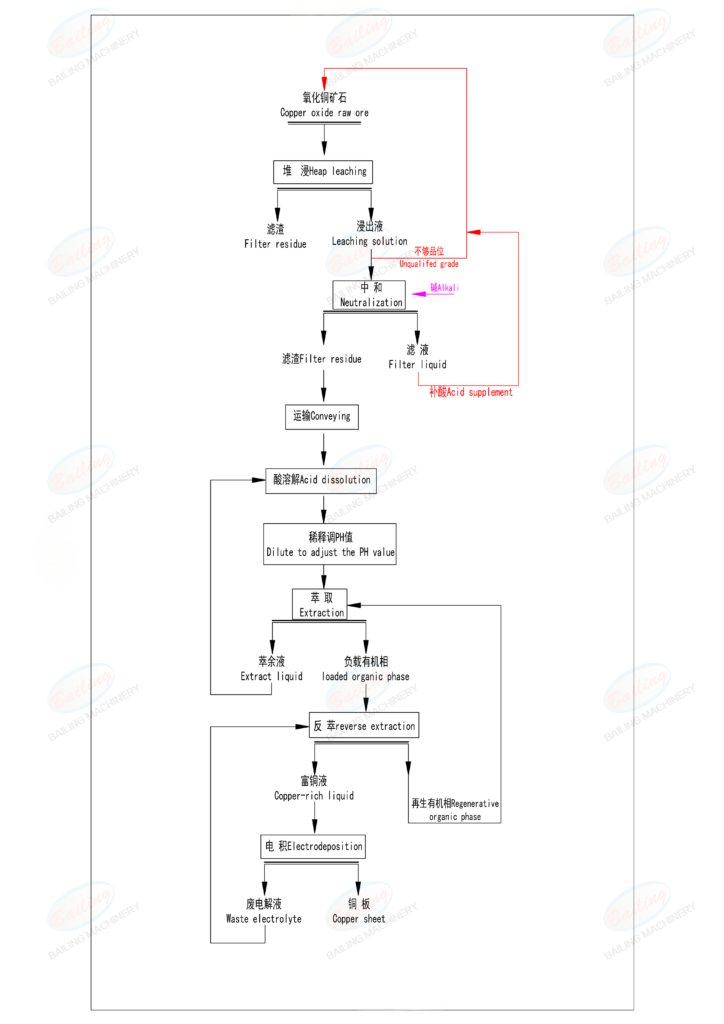
Copper Ore Extraction Electrowinning Process Flowchart
Related Case Study
Henan Bailin Machinery adopted the electrodeposition process for a low-grade copper oxide mine (containing 0.8% copper) in Shanxi Province: Firstly, the ore was heap leached with sulfuric acid solution. The leachate was neutralized and precipitated to remove iron and aluminum impurities, and then purified through solvent extraction to obtain a high-concentration copper sulfate electrolyte. Subsequently, electrolysis was carried out in the electrolytic cell with a titanium-based coated anode and a starting plate cathode. The current density was controlled at 160A/m² and the cell voltage at 2.3 V. Eventually, cathode copper with a purity of 99.97% was produced. The unit energy consumption was reduced by 35% compared to the traditional pyrometallurgical method. At the same time, the leachate residue was treated harmlessly, and the comprehensive recovery rate exceeded 92%.