Gold Ore Flotation Process
Gold ore flotation is one of the core technologies in modern gold beneficiation. It is widely applied in the gold recovery process for refractory gold ores—specifically those characterized by fine-grained dissemination or polymetallic association. Globally, this process accounts for approximately 40% to 50% of total gold production.
I. Basic Principles of Gold Ore Flotation
The gold ore flotation method achieves separation based on differences in the physicochemical properties of mineral surfaces. By adding collectors (such as xanthates), a selective adsorption occurs on the surfaces of gold-bearing minerals or their carrier minerals, thereby rendering them hydrophobic. Subsequently, frothers (such as pine oil or MIBC) are introduced to generate a stable foam layer; the hydrophobic minerals attach to rising air bubbles and float to the surface of the mineral slurry, forming a gold concentrate, thereby achieving separation from hydrophilic gangue minerals.
This process is typically conducted under neutral or weakly alkaline conditions. Lime is commonly used to adjust the pH of the mineral slurry to a range of 8–9, a measure designed to enhance the efficacy of the collectors while simultaneously suppressing the flotation of certain impurity minerals.
II. Main Types of Flotation Processes
1. Conventional Flotation Processes
- Single Flotation: Suitable for ores where gold minerals exhibit a high degree of liberation (dissociation) and the gangue composition is relatively simple. After crushing and grinding, the ore proceeds directly to the flotation operation.
- Stage Grinding and Flotation: Designed for ores where gold minerals are disseminated in varying grain sizes. Coarse grinding is performed first to recover coarse-grained gold; the tailings are then subjected to finer grinding and flotation to recover fine-grained gold, thereby minimizing losses caused by over-grinding.
- Split-Flow Flotation: Applicable to ores with high clay content. The middlings (intermediate products) are returned early in the circuit to be combined with the fresh feed for re-processing, thereby reducing the circulating load within the system.
2. Combined Process Flowsheets
- Flotation–Cyanidation: Flotation is used to enrich the gold content and produce a gold concentrate, which is then subjected to cyanide leaching for final gold extraction. This method is suitable for complex polymetallic ores.
- Gravity Separation–Flotation:Gravity separation equipment—such as jigs or shaking tables—is utilized first to recover coarse-grained gold; the tailings are then processed via flotation to recover fine-grained gold, thereby enhancing the overall recovery rate.
- Flotation–Roasting–Cyanidation: Employed for refractory gold ores containing deleterious elements such as arsenic or sulfur. Roasting is performed to remove these harmful substances, thereby facilitating the subsequent leaching process. III. Key Equipment and Reagent Systems
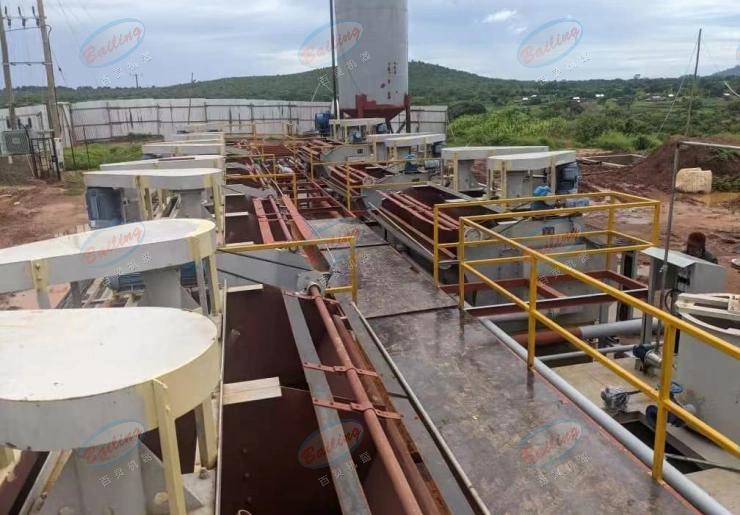
Primary Flotation Equipment
- Mechanically Agitated Flotation Machines: Feature a self-aerating capability; common models include:
- SF Series: Suitable for roughing and scavenging operations in medium-to-large-scale beneficiation plants.
- JJF Series: Suitable for scavenging and cleaning operations in all types of beneficiation plants.
- BF Series: Suitable for roughing operations in small-to-medium-scale beneficiation plants.
- Aerated-Agitated Flotation Machines: Require an external blower to supply air (e.g., XCF and KYF series); suitable for large-scale beneficiation plants.
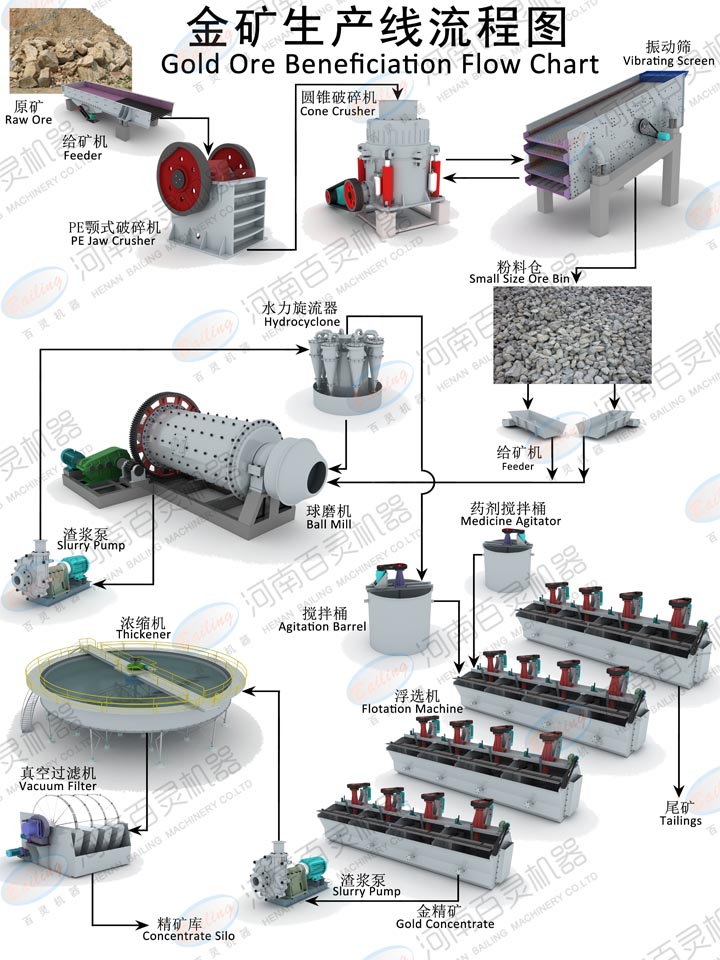
Gold ore beneficiation process flow