Description
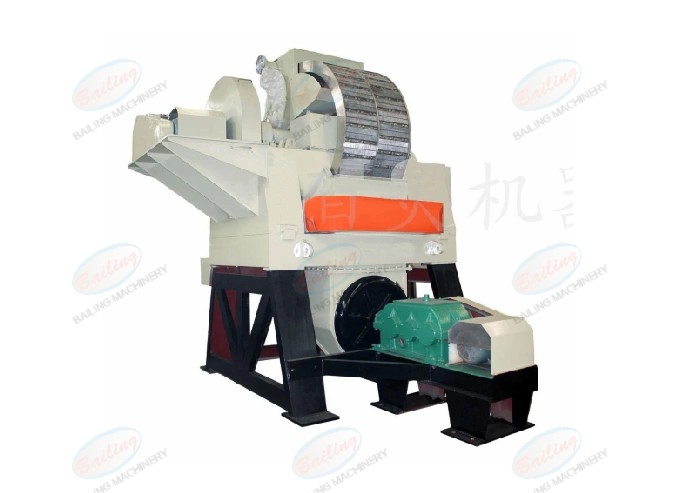
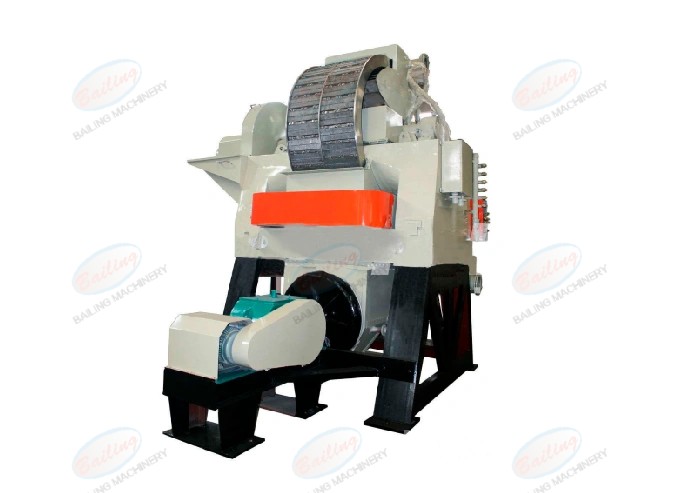
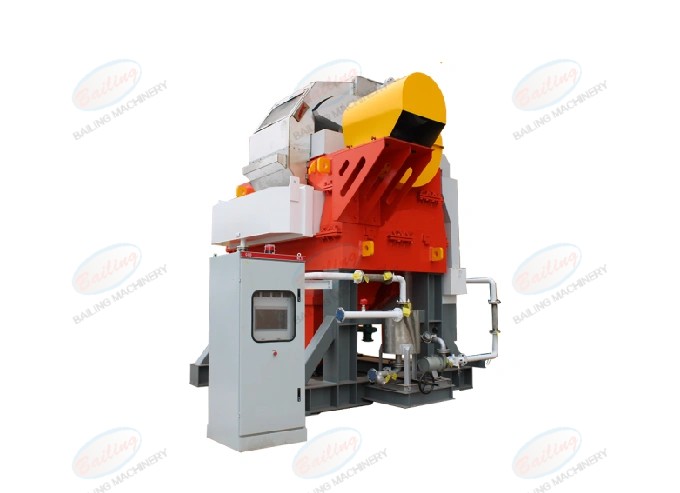
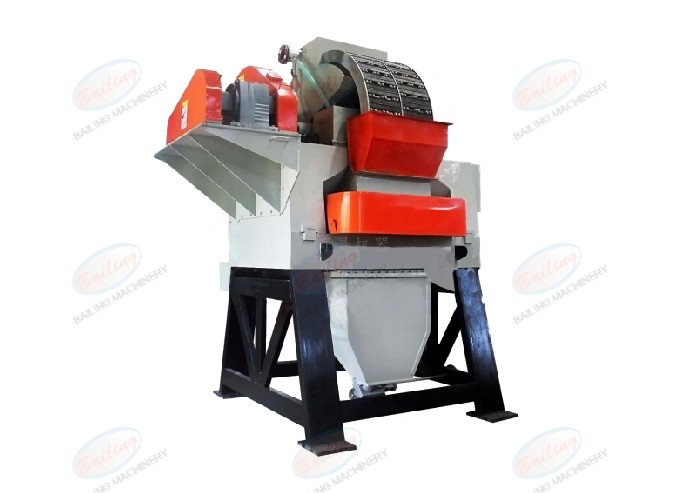
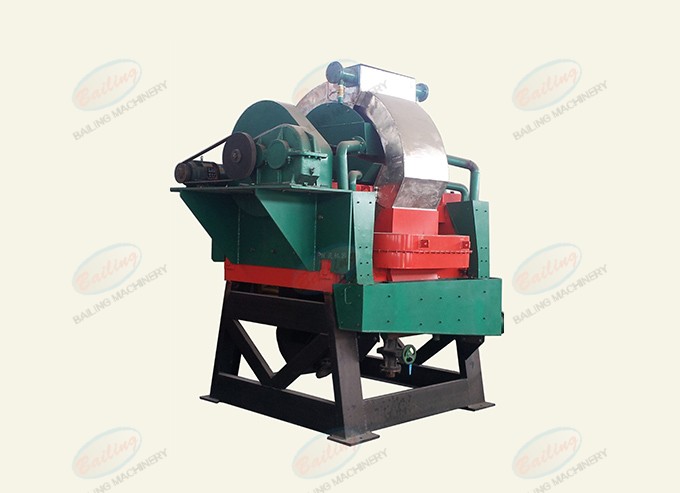
The vertical ring high-gradient magnetic separator is a type of strong magnetic separator used for screening weakly magnetic minerals. The vertical rotation of the rotating ring and the backflushing of the concentrate are adopted, and it is equipped with a high-frequency vibration mechanism, which fundamentally solves the worldwide technical problem that the magnetic medium is prone to clogging in the flat ring strong magnetic separator and the flat ring high gradient magnetic separator.
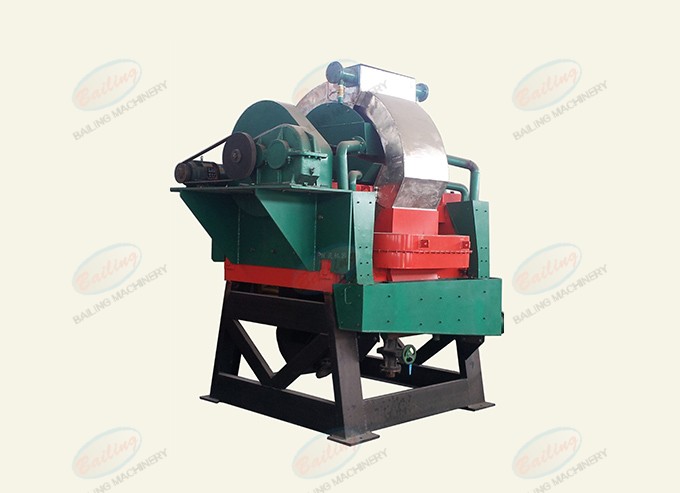
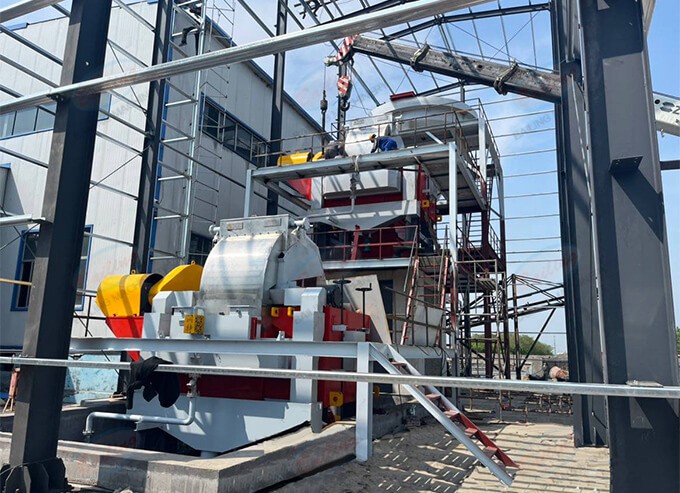
Applicable materials: Wet separation of various weakly magnetic metal ores such as hematite, limonite, siderite, manganese ore, ilmenite and wolframite; Impurity iron removal and purification of non-metallic minerals such as quartz, feldspar, nepheline and kaolin.
Advantages
Structure drawing
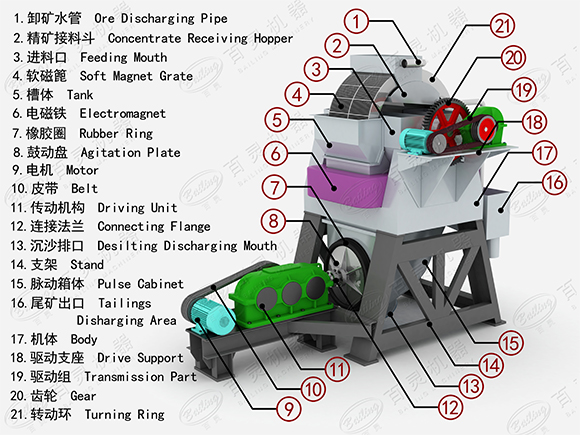
The high-gradient magnetic separator equipment mainly consists of a pulsating mechanism, excitation coils, iron yokes and rotating rings, etc. The rotating ring is composed of 74 sorting chambers formed by one central ring plate, two side ring plates and 74 trapezoidal partitions processed from ordinary stainless steel.
Parameter
| Model | φ500 | φ750 | φ1000 | φ1250 | φ1500 | φ1750 | φ2000 | φ2500 | φ3000 |
| Rated background field strength (T) | 1.3T(1.8T) constant-current continuously adjustable | ||||||||
| Dielectric induced magnetic field | 2.1T(3.6T) constant-current continuously adjustable | ||||||||
| Rated excitation power (KW) | ≤20(28) | ≤30(42) | ≤37(56) | ≤45(27) | ≤50(84) | ≤65(100) | ≤80(119) | 90(138) | ≤110(154) |
| Dry ore handling capacity (t/h) | 0.03~0.125 | 0.1~0.5 | 4~7 | 10~18 | 20~30 | 30~50 | 50~80 | 100~150 | 150~250 |
| Slurry passing capacity (m3/h) | 0.25~0.5 | 1~2 | 12.5~20 | 20~50 | 50~100 | 75~150 | 100~200 | 200~400 | 350~650 |
| Excitation current (A) | 42 | 64 | 85 | 105 | 127 | 153 | 180 | 207 | 233 |
| Feed concentration (%) | 10-40 | ||||||||
| Feed size (mm) | -1.0 | -1.0 | -1.2 | -1.2 | -1.2 | -1.2 | -1.2 | -1.2 | -1.2 |
| Rotating ring speed (r/min) | 3 | ||||||||
| Outside diameter of rotating ring (mm) | Φ500 | Φ750 | Φ1000 | Φ1250 | Φ1500 | Φ1750 | Φ2000 | Φ2500 | Φ3000 |
| Rotary motor power (KW) | 0.18 | 0.75 | 1.1 | 1.5 | 3 | 4 | 5.5 | 11 | 18.5 |
| Pulsating motor power (KW) | 0.55 | 1.5 | 2.2 | 3 | 3 | 4 | 7.5 | 11 | 18.5 |
| Pulsating stroke (mm) | 0~30 (the machine can be adjusted) | ||||||||
| Pulsating impulse (times/min) | 0~300 (variable frequency adjustable) | ||||||||
| Excitation voltage (DCV) | 0-514(700)(varies with current) | ||||||||
| Discharge water pressure (Mpa) | 0.1~0.2 | 0.1~0.2 | 0.2~0.4 | 0.2~0.4 | 0.2~0.4 | 0.2~0.4 | 0.2~0.4 | 0.2~0.4 | 0.2~0.4 |
| Discharge water consumption (m3/h) | 0.65~1.4 | 1.4~2.5 | 8~12 | 12~20 | 20~30 | 30~50 | 50~100 | 100~150 | 150~250 |
| Main engine weight (t) | 3(1.5) | 6(6.5) | 13(19.5) | 20(31.2) | 30(44) | 40(58) | 52(78) | 105(163) | 155(215) |
| Maximum component weight (t) | 0.5(0.25) | 1.1(1.15) | 3.3(3.7) | 5(6.5) | 7(11) | 15(19) | 20(23) | 32(38) | 38(45) |
| Overall Dimensions Length x width x Height (mm) | 1800×1400×1320 | 2000×1360×1680 | 2700×2000×2400 | 3200×2340×2700 | 3600×2900×3200 | 3900×3300×3800 | 4200×3550×4200 | 5800×5000×5400 | 7600×6500×7200 |
Structure drawing
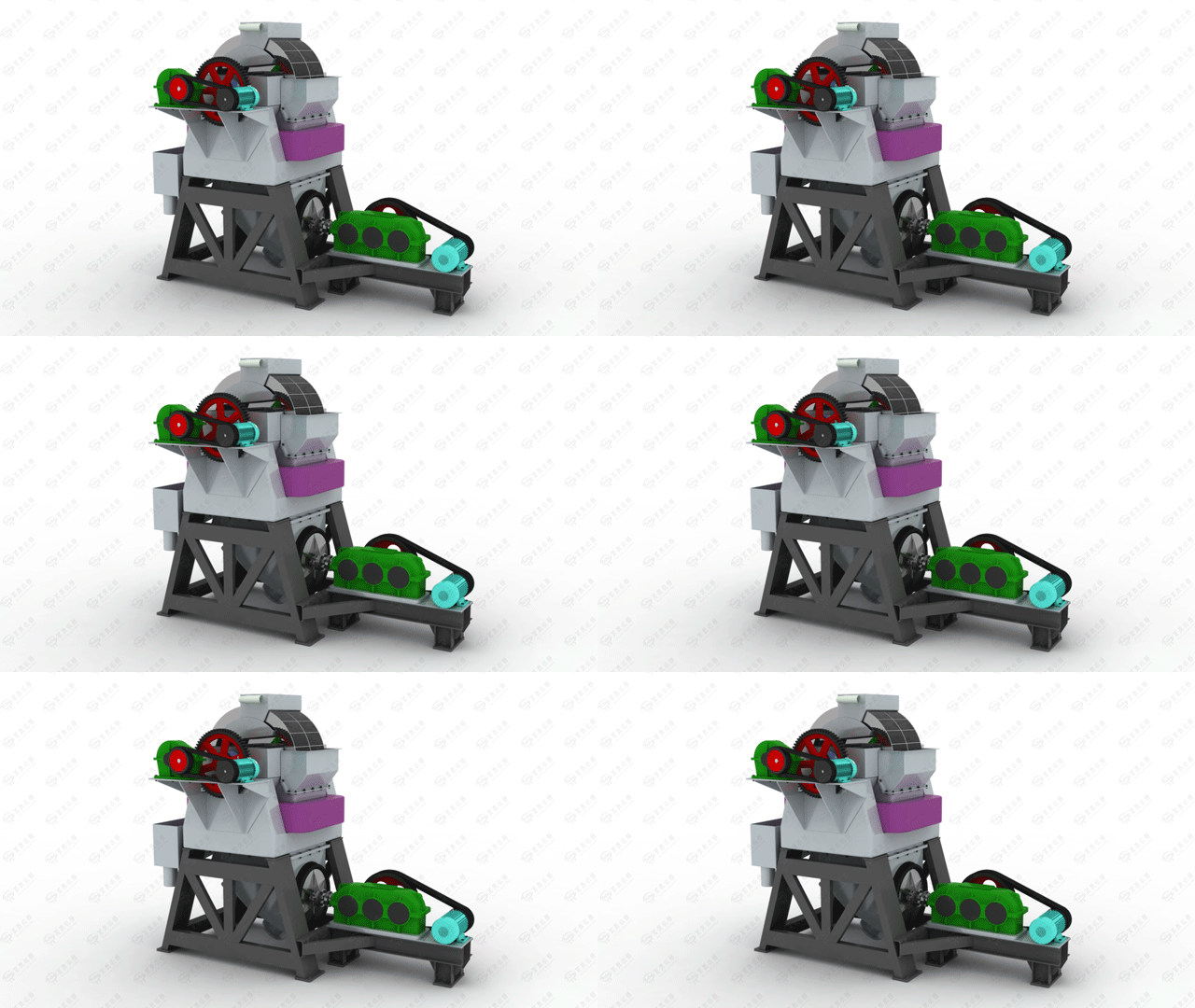
When the high-gradient magnetic separator is in operation, the slurry flows into the tank through the feeding box. Under the action of the water flow in the feeding spray pipe, the ore particles enter the feeding area of the tank in a loose state. Under the influence of a magnetic field, magnetic mineral particles undergo magnetic agglomeration to form “magnetic clusters” or “magnetic chains”. These “magnetic clusters” or “magnetic chains” are subjected to magnetic force in the pulp and move towards the magnetic poles, being adsorbed onto the cylinder. Because the polarity of the magnetic poles is alternately arranged along the rotation direction of the cylinder and remains fixed during operation, when the “magnetic clusters” or “magnetic chains” rotate with the cylinder, the magnetic stirring phenomenon occurs due to the alternation of the magnetic poles. The gangue and other non-magnetic minerals mixed in the “magnetic clusters” or “magnetic chains” fall off during the flipping process. The “magnetic clusters” or “magnetic chains” that are ultimately adhered to the surface of the cylinder are the concentrate. The concentrate rotates along with the cylinder to the edge of the magnetic system where the magnetic force is the weakest. Under the action of the flushing water flow sprayed out from the unloading pipe, it is discharged into the concentrate tank. Non-magnetic or weakly magnetic minerals remain in the pulp and are discharged out of the trough with the pulp, which is known as tailings.