Project Background
This deposit belongs to high-temperature metamorphic crystalline graphite ore. The graphite crystals are flaky but closely coexist with gangue minerals such as mica, quartz and feldspar, and some of the scales are wrapped by clay minerals. The customer is confronted with the following core issues:
- It is difficult to protect large flakes: The traditional grinding process is prone to damaging the structure of graphite flakes, resulting in a yield of +50 mesh (0.3mm) large flakes being less than 30%.
- Low gangue separation efficiency: The floatability of mica and graphite is similar, and the fixed carbon content of the concentrate is only 88%, which cannot meet the requirements of anode materials for lithium-ion batteries (≥99.5%).
- Large loss of fine particle size: The recovery rate of -200 mesh (0.074mm) fine particle graphite is less than 60%, and the resource utilization rate is low.
Analysis of Ore Characteristics
| Element | Fixed carbon | SiO₂ | Al₂O₃ | K₂O+Na₂O | Fe₂O₃ |
| Content(%) | 8.2 | 12.5 | 8.3 | 4.6 | 2.1 |
| Flake diameter | 0.5~2mm(65%) | Main components of gangue | Main components of mica | Alkaline oxides interfere with flotation | Trace amounts exist |
Process design
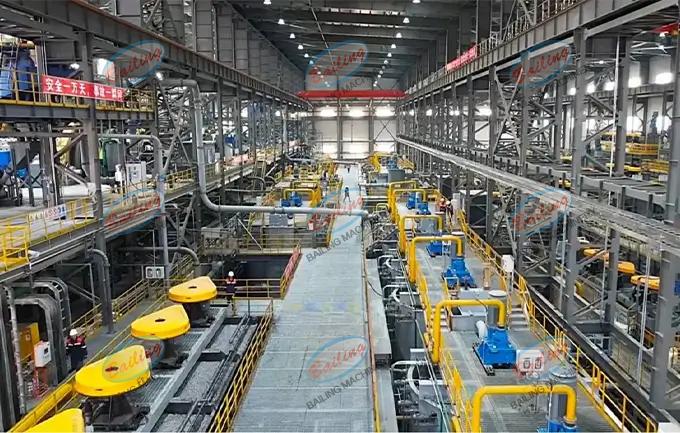
In view of the characteristics of the ore, a combined process of “staged protection grinding – multi-stage flotation – large scale classification – chemical purification” is adopted. The core process is as follows:
- The ore is crushed to -50mm by a jaw crusher, and the coarse particles of +20mm (with a yield of 15%) are separated by a vibrating screen and directly discarded (with a fixed carbon content of less than 3%), reducing the subsequent processing volume.
- First stage grinding: Use a rod mill (with steel rods of 60 to 80mm in diameter) to grind the ore to -1mm, control the overgrinding rate to be less than 20%, and protect the large scale structure.
- Second-stage grinding: A vertical spiral stirred mill (with φ6mm alumina ceramic balls as the medium) is used to finely grind -1mm materials to -0.074mm, accounting for 65%, ensuring the dissociation of graphite monomers.
- Rough selection: Diesel (300g/t) was used as the collector, No.2 oil (20g/t) as the foaming agent, and water glass (500g/t) was added to inhibit silicate minerals, obtaining rough concentrate (with a fixed carbon content of 15.2%).
- Fine selection: The “one coarse and three fine” process is adopted. Lime (pH=9.5) is added in each stage of selection to suppress mica, and the fixed carbon content of the final concentrate reaches 94.5%.
- Sweeping: The medium ore is returned to the roughing cycle, and the tailings are reground and then subjected to secondary flotation to increase the recovery rate.
- The flotation concentrate is classified into three particle sizes by wet vibrating screen: +50 mesh (0.3mm), -50 to +100 mesh (0.15 to 0.3mm), and -100 mesh (< 0.15mm)
- For the +50 mesh large scales, low-temperature (150℃) air drying should be adopted to avoid the scales from cracking due to high-temperature drying.
- For the demand of battery-grade graphite, a mixed acid leaching process of hydrofluoric acid (5%) + hydrochloric acid (10%) is adopted, with a temperature of 60℃ and a duration of 3 hours. Impurities such as silicon and iron are removed to produce ultra-pure graphite with a fixed carbon content of ≥99.8%
Technological innovation points
- The combination of rod mill and ceramic ball stirring mill reduces overgrinding, and the yield of 50-mesh large flakes has been increased from 28% in the traditional process to 42%.
- Develop a “lium-ferrous sulfate” compound inhibitor to selectively inhibit mica under pH=9.5 and reduce the inhibitory effect on graphite.
- The air circulation drying system is adopted to avoid the damage to the scale structure caused by high temperature. The tapped density of the finished product reaches 1.02g/cm³ (the industry average is 0.85g/cm³).
- Tailings are treated by magnetic separation to recover iron minerals (with a Fe grade of 45%) and by flotation to recover mica (with a K₂O content of 12%), achieving zero waste discharge
Implementation effect
1. Significant improvement in indicators:
• The fixed carbon content of graphite concentrate has increased from 88% to 94.5% (reaching 99.8% after acid leaching).
• The yield of +50 mesh large scales increased by 14 percentage points, and the recovery rate of fine particle grade (-200 mesh) rose from 60% to 78%.
2. Economic benefits:
• The price of large flake graphite is 30% higher than that of ordinary graphite, and the annual income of the project has increased by more than 20 million yuan.
• The cost of chemical purification is 40% lower than that of the traditional high-temperature alkali fusion method.