Project Background
This deposit belongs to the surface weathering type of manganese deposit. The manganese minerals are mainly soft manganese ore (MnO₂) and hard manganese ore (mMnO·nMn₂O₃·H₂O), with a fine distribution size (75% of which is -0.045mm), and are closely associated with iron minerals (hematite, limonite) and clay minerals. The customer is facing the following challenges:
- The grade of the raw ore is low, the impurity content is high, and the direct sales value is low.
2. The separation of manganese and iron is difficult, and the effect of traditional gravity separation is poor.
3. Phosphorus content exceeds the standard (industry standards require Mn/Fe > 6, P < 0.1%), and thorough impurity removal is necessary.
Analysis of Ore Characteristics
| Element | Mn | Fe | P | SiO₂ | Al₂O₃ |
| Content(%) | 12.5 | 8.2 | 0.15 | 18.6 | 6.3 |
| Specificity | Coarse-grained fabric is the main type | The main components of gangue | Associated with fluorite | It exists in the form of cementation |
Technical solution
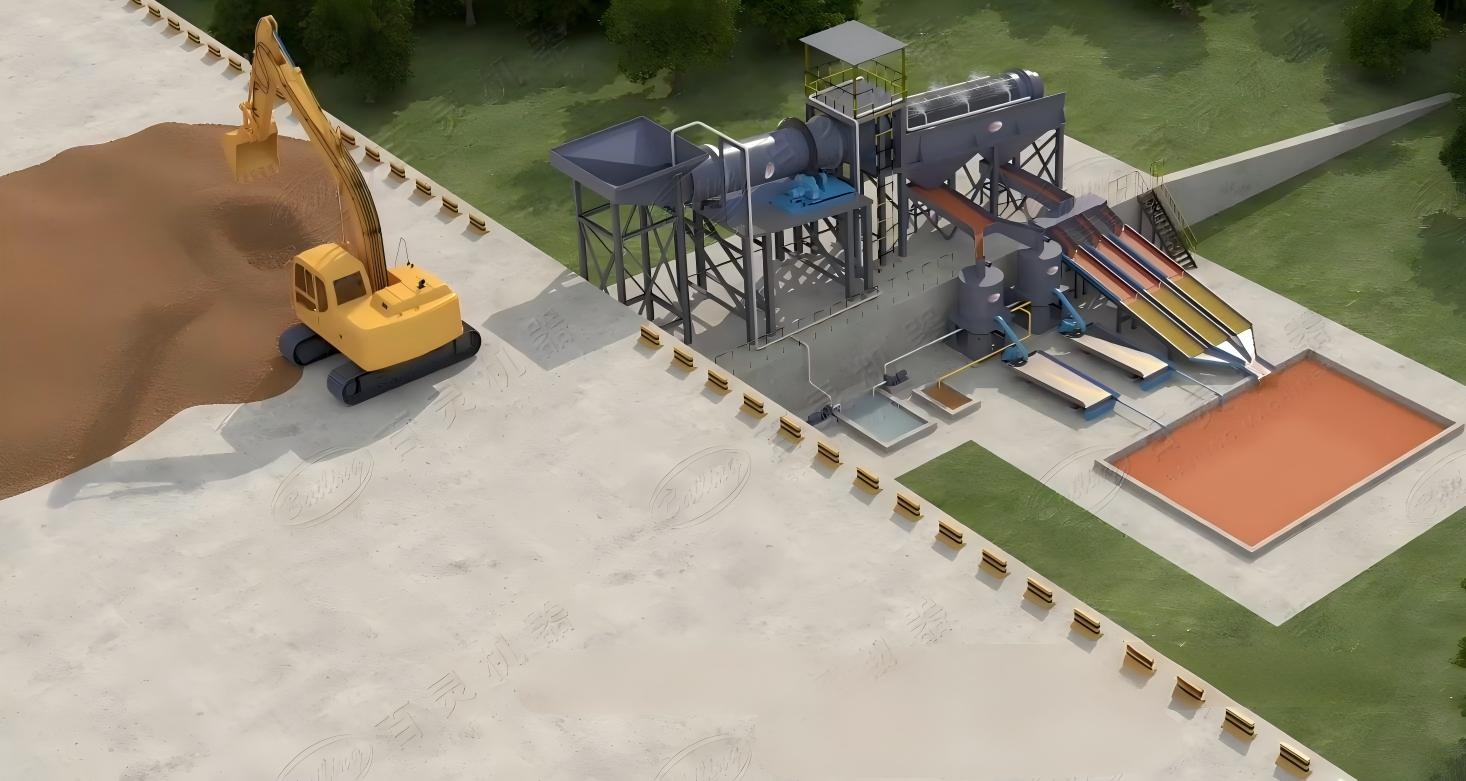
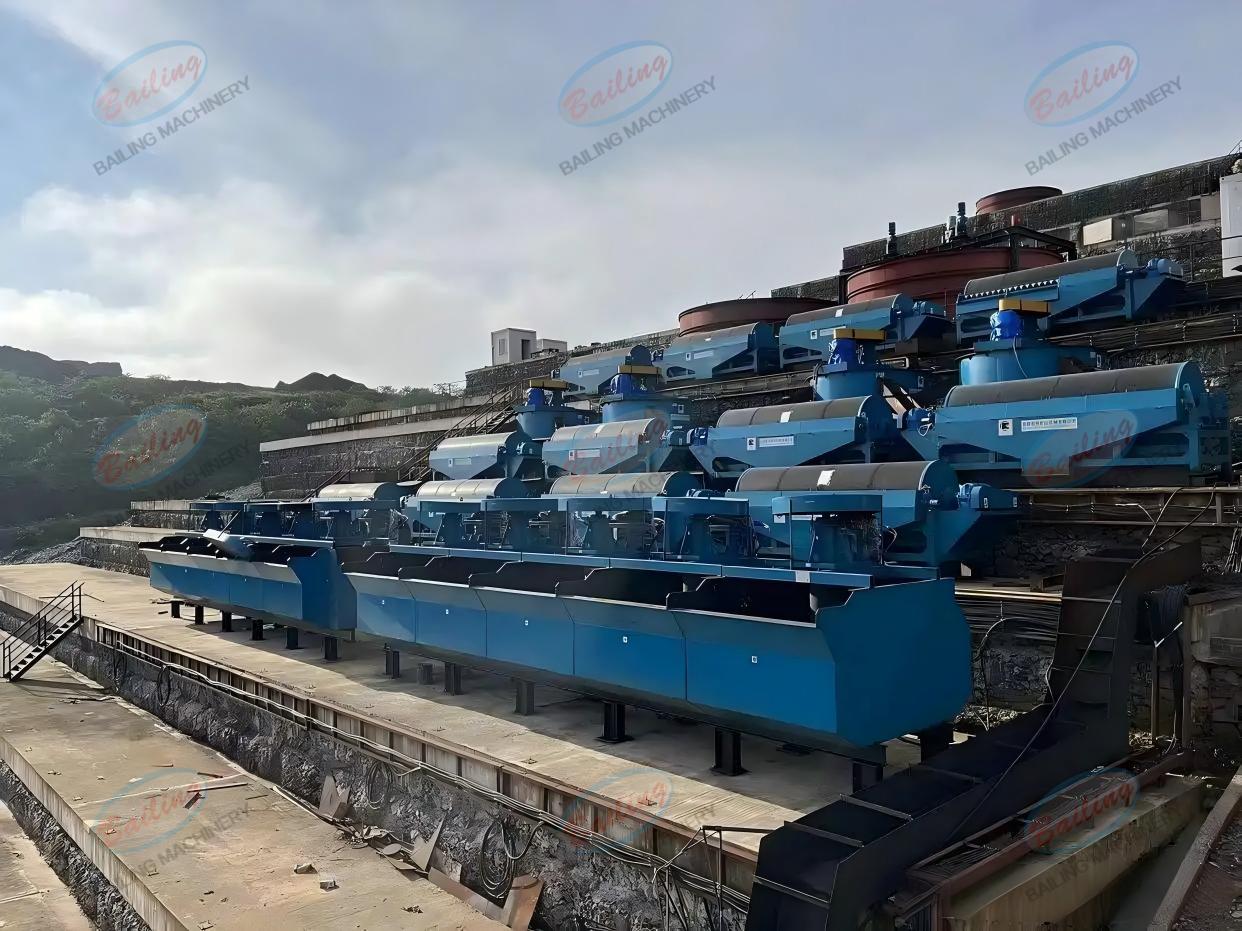
In view of the characteristics of the ore, a combined process of “ore washing – magnetic separation pre-tailings – strong magnetic separation iron removal – flotation phosphorus reduction” is adopted. The core process is as follows:
- A double-spiral trough type ore washing machine is adopted, with water added and stirred (liquid-solid ratio 3:1) to remove slime (yield 15%), reducing interference in subsequent processes.
The +3mm coarse particles screened out are directly discarded (Mn grade < 5%), reducing the processing volume.
- Use a weak magnetic separator (magnetic field intensity 0.1T) to recover part of the magnetic iron minerals (yield 3%, Fe grade 45%), reducing the subsequent strong magnetic separation load.
- A vertical ring high-gradient magnetic separator (with a background field strength of 1.2T) was adopted, and the pulsating impact was 200 times per minute to obtain manganese concentrate 1 (with a Mn grade of 18.5% and a Fe content reduced to 3.2%).
The tailings were further subjected to secondary strong magnetic separation (with a field strength of 0.8T) to recover manganese, and the total manganese recovery rate after consolidation was 88%.
Sodium carbonate (1000g/t) was used as the pH adjuster and water glass (500g/t) as the dispersant to inhibit silicate minerals.
Modified fatty acid collectors (200g/t) were used to selectively float apatite, and phosphorus concentrate (with a P₂O₅ grade of 25%) was obtained through a one-crude and two-fine process.
The Mn grade of the final manganese concentrate 2 (derived from the flotation tailings) was increased to 22.1%, while the P content was reduced to 0.08%.
Manganese concentrate 1 and manganese concentrate 2 were combined, and after concentration and filtration, the final product (Mn grade 21.8%, Fe/Mn ratio 0.147, P content 0.07%) was obtained, which met the standard for electrolytic manganese raw materials.
Implementation effect
- 1. Significant improvement in indicators:
- The grade of manganese concentrate has been raised from 12.5% to 21.8%, and the recovery rate is 85.3%.
- The iron impurity content dropped from 8.2% to 3.2%, and the phosphorus content decreased from 0.15% to 0.07%.
- 2. Cost Optimization
- By reducing the processing capacity by 20% through pre-tailings washing, the power consumption per ton of ore is lowered by 15%.
- The modified collector has reduced the cost of flotation reagents by 25%.