Project Background
This deposit belongs to the medium and low-temperature hydrothermal filling type of fluorite ore. Fluorite (CaF₂) is mainly coarse-grained intercalated, but closely coexists with quartz (SiO₂) and calcite (CaCO₃), and some fluorite particles are encapsulated by silicate minerals. The customer is confronted with the following core issues:
- High content of silicon-calcium impurities: The CaF₂ grade of traditional flotation concentrate is only 85%, which cannot meet the requirements of metallurgical grade (≥97%) or chemical grade (≥93%).
- High consumption of chemicals: The floatability of calcite and fluorite is similar, resulting in a high dosage of inhibitors (sodium silicate consumption per unit > 5kg/t);
- Severe interference from fine mud: The -0.038mm particle size in the ore accounts for 25%, which affects the selectivity of flotation.
Analysis of Ore Characteristics
| Element | CaF₂ | SiO₂ | CaCO₃ | Al₂O₃ | Fe₂O₃ |
| Content(%) | 32.6 | 38.5 | 12.3 | 3.2 | 1.8 |
| Specificity | Coarse-grained fabric is the main type | The main components of gangue | Associated with fluorite | It exists in the form of cementation | Trace amounts exist |
Technical solution
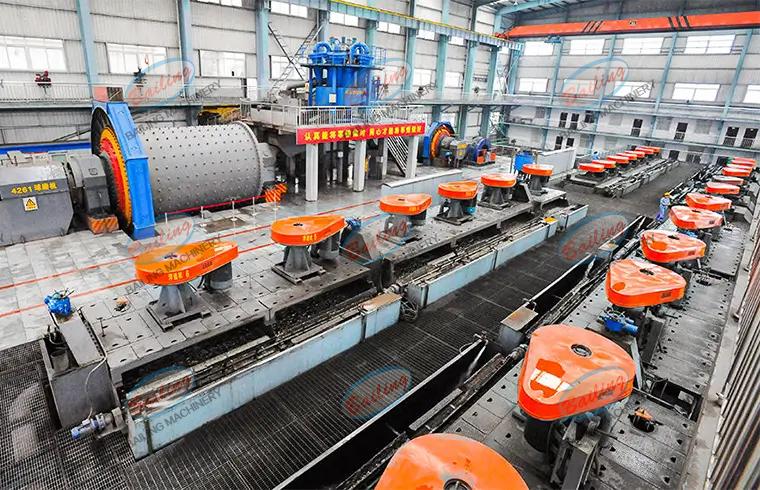
According to the characteristics of the ore, a combined process of “staged grinding – classification and slurry adjustment – inhibition of silicon-calcium flotation fluorite” is adopted. The core process is as follows:
- The first section is crushed to -15mm by a jaw crusher and a cone crusher.
- The two-stage ball mill and the screw classifier form a closed circuit, with 75% of the grinding fineness controlled at -0.074mm;
- The -0.038mm fine sludge (with a yield of 15%) was separated through a hydrocyclone and treated separately to minimize interference with the main process
- For fine sludge, “oleic acid (300g/t) + diesel (100g/t)” was used as the collector, and No. 2 oil (20g/t) was used as the foaming agent. Coarse and fine sweeping was carried out to recover part of the fluorite in advance (yield 3%, CaF₂ grade 65%), reducing the load of subsequent processes.
- Slurry adjustment: Add sodium carbonate (1000g/t) to adjust the pH to 8.5 and disperse the mineral sludge.
- Inhibitor: Modified water glass (modulus 2.8, dosage 800g/t) was used to inhibit quartz, and sodium hapetaphosphate (200g/t) was used to assist in dispersion.
- Calcium inhibitor: Add citric acid (300g/t) to inhibit calcite and reduce its interference with fluorite;
- Collector: Use a combined collector (oleic acid: cocamidopropyl betaine =3:1, total dosage 400g/t) to enhance fluorite selectivity;
- Process: After one coarse, two fine and two sweeps, the main fluorite concentrate (with a CaF₂ grade of 92.5%) is obtained.
The fine mud flotation concentrate and the main fluorite concentrate were combined, and after concentration and filtration, the final product (CaF₂ grade 93.1%) was obtained.
The concentrate was refined by acid leaching (with 10% HCl added, at 60℃ for 2 hours) to further remove calcium and magnesium impurities and produce ultra-pure fluorite powder (with a CaF₂ grade of 97.8%).
Implementation effect
- Significant improvement in indicators:The grade of fluorite concentrate has increased from 85% in the traditional process to 93.1% (97.8% after acid leaching), and the recovery rate is 82.5%.The content of silicon-calcium impurities has been significantly reduced: SiO₂ has dropped from 8.5% to 3.2%, and CaCO₃ has decreased from 4.2% to 1.5%.
- Cost Optimization:Modified sodium silicate reduces the dosage of inhibitors by 40% and lowers the cost of chemicals per ton of ore by 22%.The separate treatment of fine mud reduces the repetitive grinding in the main process and lowers power consumption by 15%.