Project Background
This deposit represents a typical polymetallic antimony sulfide ore. The primary antimony mineral is stibnite (Sb₂S₃), which is intimately associated with pyrite, galena, and sphalerite. The minerals exhibit a fine dissemination grain size, with 65% of the particles being finer than 0.037 mm. The client faced the following core challenges:
- 1. Difficulty in Antimony-Sulfur Separation: Stibnite and pyrite possess similar floatability characteristics; consequently, traditional reagent regimes yielded recovery rates of less than 70%.
- 2. Lead and Zinc Interference: The presence of galena and sphalerite resulted in a low concentrate grade (Sb < 40%).
- 3. Fluctuating Oxidation Levels: The oxidation rate on the ore surface reached 15%, compromising the stability of the flotation process.
Analysis of Ore Characteristics
| Element | Sb | S | Pb | Zn | SiO₂ |
| Content(%) | 1.5 | 12.3 | 0.8 | 0.5 | 28.6 |
| Specificity | Coarse-grained fabric is the main type | The main components of gangue | Associated with fluorite | It exists in the form of cementation | Trace amounts exist |
Technical solution
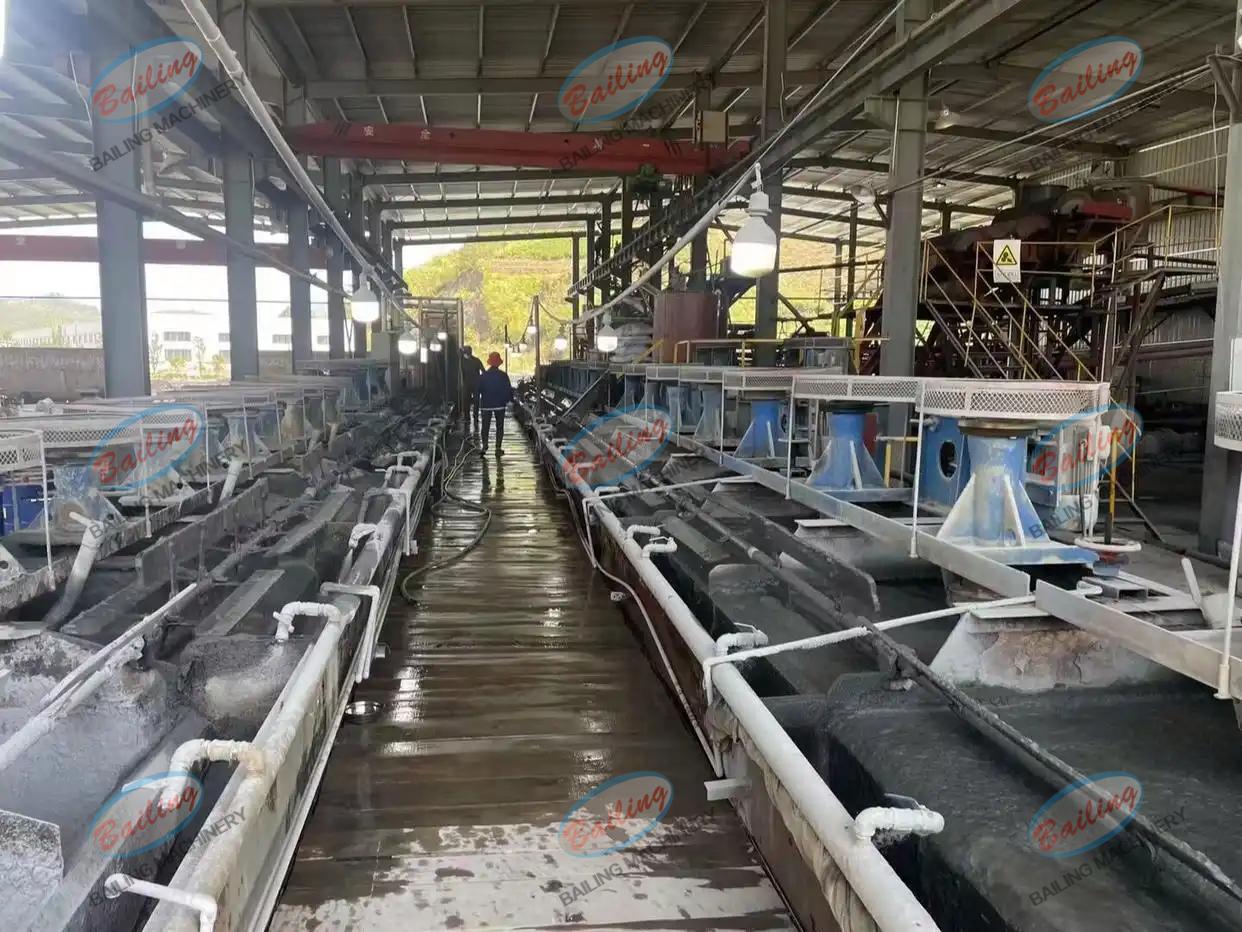
Based on the specific characteristics of the ore, a combined process featuring “Stage Grinding —Sulfur Depression & Antimony Flotation — Lead-Zinc Separation” was adopted. The core process flow is outlined below:
- Stage 1: Utilizes a jaw crusher followed by a cone crusher to reduce the ore size to -12 mm.
- Stage 2: A ball mill operates in a closed circuit with a spiral classifier to achieve a final fineness where 80% of the particles are finer than 0.074 mm, thereby ensuring the complete liberation of the antimony minerals. 2. Rough Flotation for Antimony (with Sulfur Depression)
- Lime (pH 10.5) and lead nitrate (200 g/t) are added to activate stibnite.
- Depressants: A mixed depressant (Zinc Sulfate:Sodium Cyanide = 3:1; total dosage: 800 g/t) is employed to depress pyrite.
- Collectors: A mixed collector comprising butyl xanthate (100 g/t) and ethyl thionocarbamate (50 g/t) is utilized to enhance antimony selectivity.
- Frothers: “No. 2 Oil” (30 g/t) is added; following a circuit consisting of one roughing stage and two cleaning stages, a rough antimony concentrate is obtained (Sb grade: 12.8%; Recovery: 82.3%).
- The rough antimony concentrate is reground until 90% of the particles pass through a 0.045 mm sieve. Through three stages of cleaning (with middlings returned to the roughing circuit), Antimony Concentrate 1 is produced (Sb grade: 45.2%).
- Lead Flotation (with Zinc Depression): Sodium sulfite (500 g/t) serves as the zinc depressant, while copper sulfate (100 g/t) acts as the lead activator. Galena is floated using butyl xanthate (80 g/t) to yield a lead concentrate (Pb grade: 58%).
- Zinc Flotation (with Lead Depression): Lime (pH 11.5) is added to the tailings to depress lead. Sphalerite is then floated using a combination of zinc sulfate (300 g/t) and butyl ammonium aerofloat (60 g/t) to yield a zinc concentrate (Zn grade: 42%).
Antimony Concentrate 1 is combined with the tailings from the antimony cleaning stages. After thickening and filtration, the final antimony concentrate is obtained (Sb grade: 43.5%; Recovery: 80.1%). The lead and zinc concentrates are marketed separately. Implementation Results
- **Significant Improvement in Key Metrics:**
* Antimony concentrate grade increased from 38% (under traditional processes) to 43.5%, while recovery rate rose from 68% to 80.1%.
* The comprehensive recovery rate for lead and zinc reached 85%, achieving maximized resource utilization.
- **Cost Optimization:**
* The use of a proprietary composite inhibitor reduced sodium cyanide consumption by 40%, lowering reagent costs per ton of ore by 18%.
* The middlings recirculation process minimized regrinding requirements, resulting in a 12% reduction in electricity consumption.